Guide · Fabrics
Outdoor fabrics that survive Dubai's sun: what to look for
A terrace in Dubai gives an outdoor fabric hours of direct sun, 42 °C summer afternoons, splashes and the odd shower. The specification shows which fabrics are built for it.
The short answer
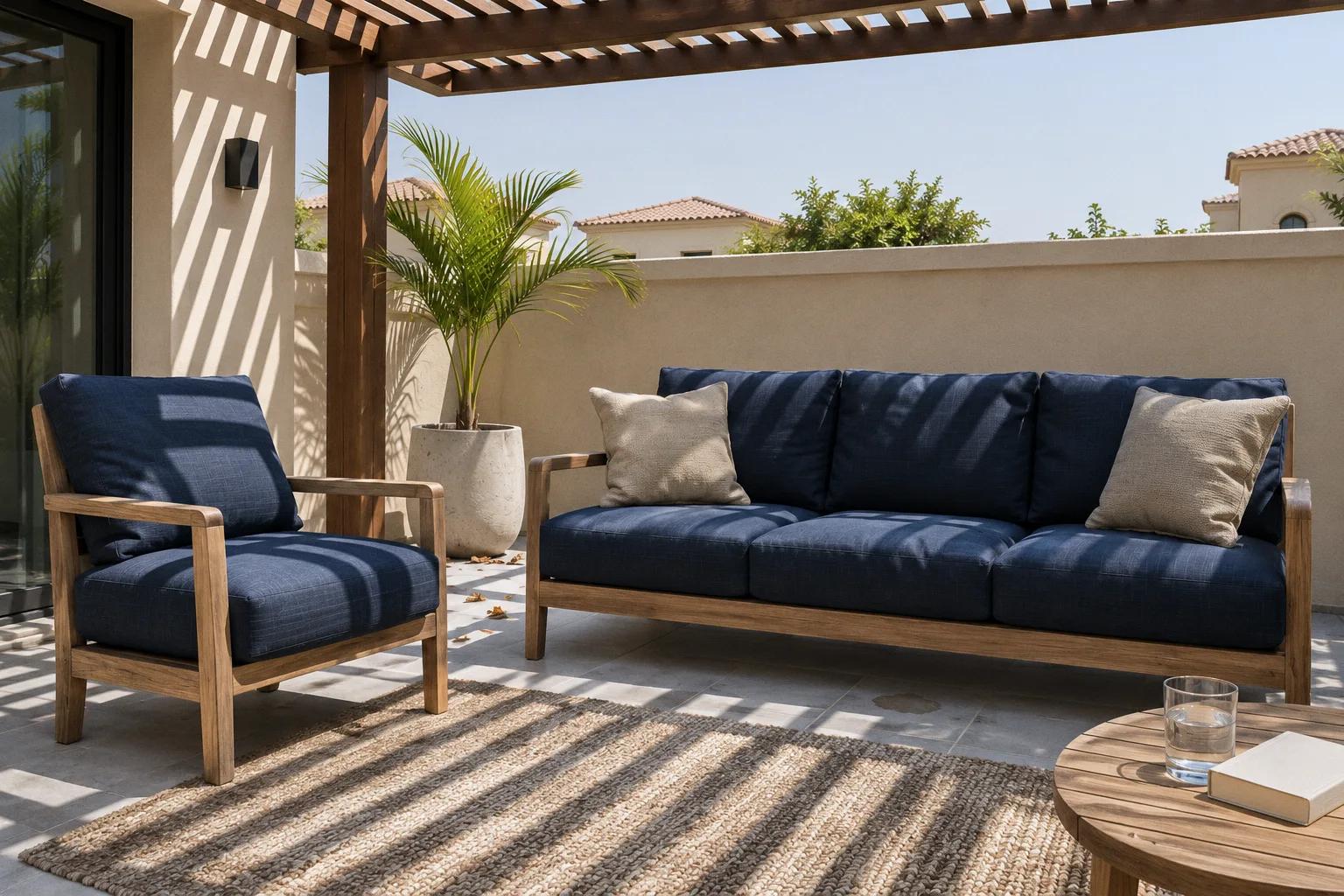
For Dubai's sun, choose a solution-dyed outdoor fabric, where the colour goes into the fibre before it is spun, with a light fastness of 7 or 8 on the 1 to 8 scale. Solution-dyed acrylic such as Meridian (UPF 50+, light fastness 8) is the most fade resistant. Pick water repellent over waterproof for cushions, and fill them with quick-dry foam.
- Solution-dyed means the colour runs through the fibre, so it fades far less than a fabric dyed or printed on its surface.
- Light fastness 7 or 8 is the figure to look for. Our Meridian is graded 8, the top of the scale.
- UPF 50+ means the fabric lets through about 1/50th of UV rays. Not every outdoor fabric lists a figure: Lido has none, so we don't claim one.
- A water repellent fabric sheds splashes and breathes; a waterproof coating stops rain but can trap moisture in the cushion.
- The foam inside matters as much as the cover: quick-dry foam lets water drain out instead of staying in.
What Dubai's sun and damp do to an outdoor fabric
Dubai's sun fades colour fast, and what a terrace cushion needs most is a fabric whose colour doesn't sit on the surface. Dubai averages about 3,570 hours of sunshine a year, and its average July and August highs are 42 °C (41.7 °C and 42.1 °C), with average humidity of about 55%, according to the Dubai Meteorological Office's figures. Summer forecasts put the UV index in the extreme band, 11 and above. In Dubai, outdoor fabrics are sold as heat proof, waterproof and UV protected; the specification shows how far each one goes.
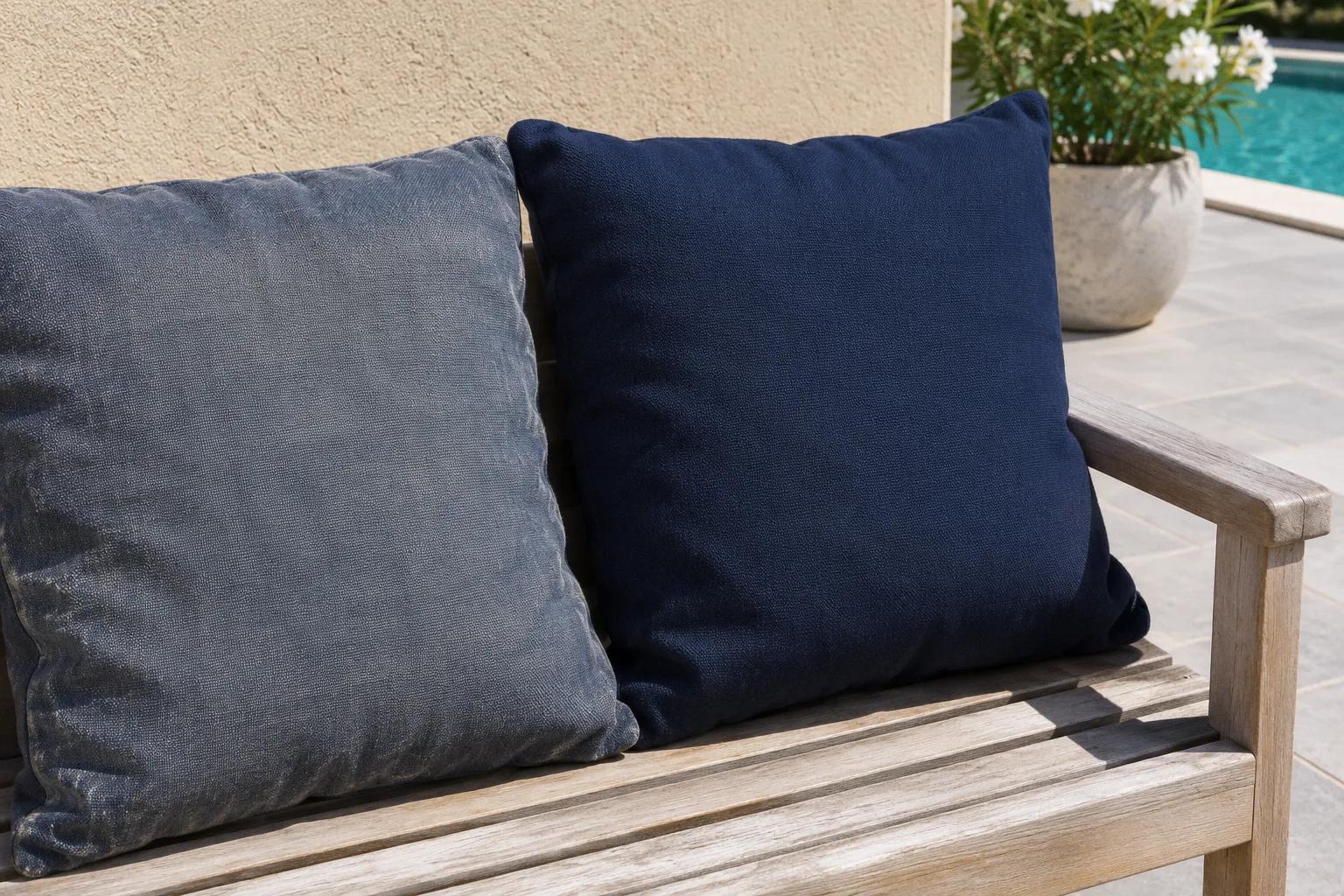
Three things wear an outdoor cushion down: sun that fades it, water that soaks it and stays, and dirt that settles in the weave. The specification of an outdoor fabric answers each one, as the next sections show.
Solution-dyed or not: the fibre question
A solution-dyed fabric has its colour added to the fibre before it is spun, so the colour runs through the yarn instead of sitting on the surface. Sunbrella, the best-known maker of solution-dyed acrylic, describes it as colour and UV stabilisers going in before the fibre is made into yarn, which makes the fabric inherently fade resistant. Printed or piece-dyed fabrics carry their colour on the surface and fade sooner.
Fibre matters too:
| Fibre | What to know | Our collections |
|---|---|---|
| Solution-dyed acrylic | Rated outstanding for UV and fade resistance | Meridian (RF-181), Siesta (RF-180) |
| Solution-dyed polyester | Colour through the fibre; strong and takes patterns | Lido (RF-179), Oasis (RF-177), Trellis (RF-172), Mariner (RF-178), Harbour (RF-183) |
| Olefin | Doesn't absorb water-based liquids | Shoreline (RF-176, solution-dyed), Deckchair (RF-182) |
| Water repellent polyester | A finish on a plain polyester; no UV or light fastness figure listed | Regatta (RF-171), Parasol (RF-174) |
The last row is the one to be careful with. Regatta and Parasol list a water repellent finish and no UV or light fastness figure, so we would keep them for shaded seating, not a terrace in full sun.
The sun numbers: light fastness, UPF and UV Standard 801
Three different figures describe how an outdoor fabric copes with sun, and they are not interchangeable.
- Light fastness says how much the colour fades. In the ISO 105-B02 test, a fabric is graded 1 to 8 against eight blue wool references under a xenon lamp, and each grade takes about twice as much light to fade as the one before. Look for 7 or 8 for a terrace in direct sun. Some makers report light fastness in hours of lamp exposure instead (AATCC 16.3), a different scale that can't be read as a grade.
- UPF (AATCC 183) says how much ultraviolet light passes through the fabric. UPF 50 lets through 1/50th, about 2%, and 50+ is the top rating. It is a sun-protection figure, made for skin; to judge fading, use light fastness.
- UV Standard 801, a protection factor of 80, is the figure some makers give: it blocks over 97% of UV rays.
What our outdoor fabrics list, as their makers give it:
| Collection | Fade (light fastness) | UV | Water |
|---|---|---|---|
| Meridian, solution-dyed acrylic | 8 (ISO 105-B02) | UPF 50+ (AATCC 183) | Oil and water repellent |
| Siesta, solution-dyed acrylic | 7 to 8 | "UV resistant", no figure | Water repellent |
| Oasis, solution-dyed polyester | 7 to 8 | 80+ (AATCC 183) | Water repellent |
| Lido, solution-dyed polyester | 1,500 hours (AATCC 16.3) | None listed | Water repellent |
| Shoreline, solution-dyed olefin | 1,000 hours | UV Standard 801, protection 80 | Water repellent |
| Mariner, solution-dyed polyester | None listed | UV Standard 801, protection 80 | Waterproof (PU coated) |
| Harbour, solution-dyed polyester | 1,500 hours | UV Standard 801, protection 80 | Waterproof (TPU coated) |
Each fabric's page in the outdoor fabrics catalogue shows the figures for that fabric. Where a figure isn't listed, we don't claim one: Lido, for example, has no UPF figure.
Water repellent or waterproof?
For cushions, water repellent is usually the better choice: it sheds splashes and light rain and still lets the fabric breathe. Makers prove it with the AATCC 22 spray test, scored out of 100, where 100 means no wetting at all and 90 only slight, scattered sticking. Lido and Meridian both list 90.
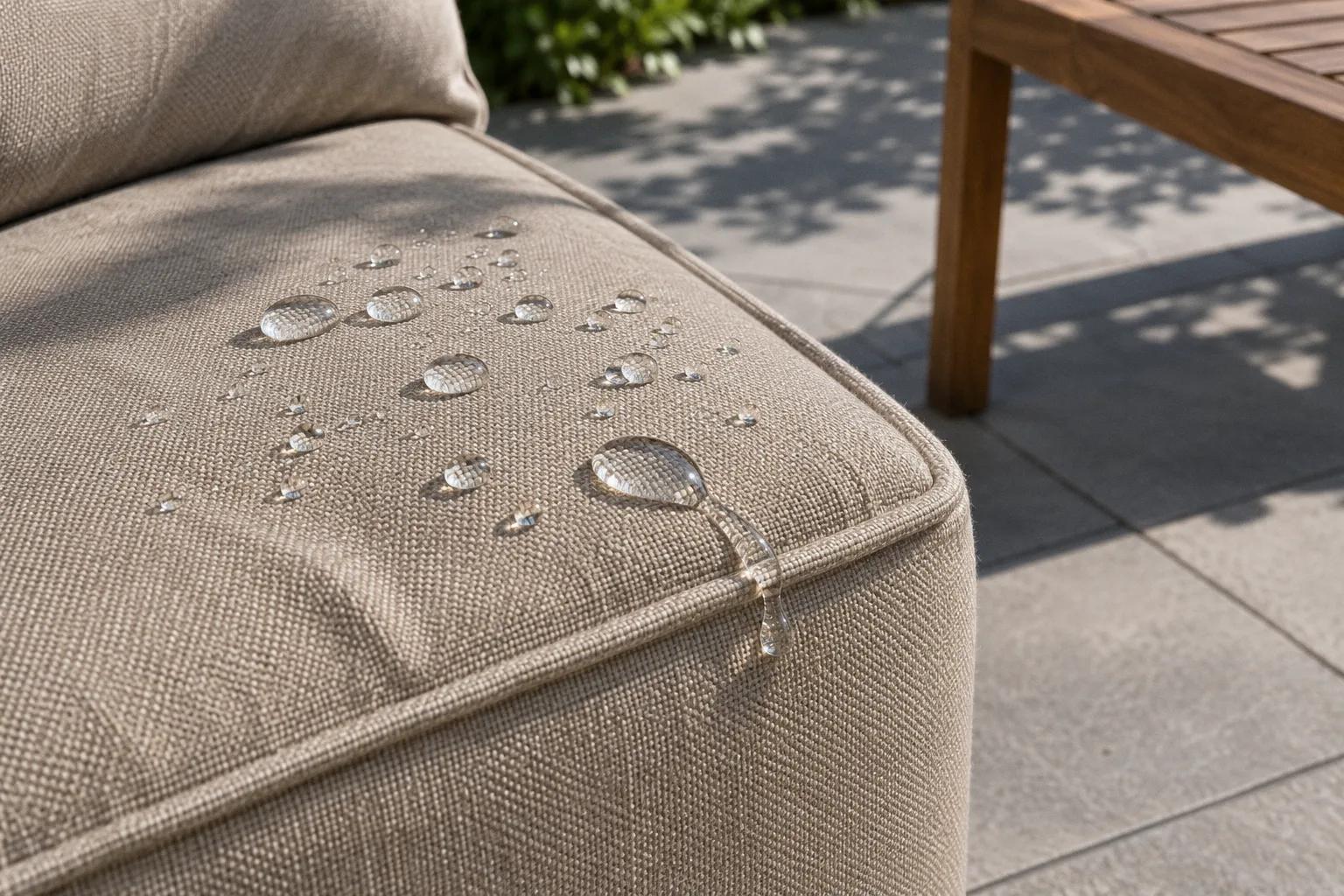
Waterproof means water can't pass through the surface, as with our Mariner (polyurethane coated) and Harbour (TPU coated), and it suits covers that stay out through rain. One cushion-care source warns that waterproof isn't always good for cushions, because any moisture that gets in has nowhere to go. The point is to keep the inside dry or let it drain, which is the foam's job.
The foam inside matters as much as the cover
Quick-dry foam, also called reticulated foam, has an open-cell structure that lets water and air pass through, so a wet cushion drains instead of holding the water. Conventional foam soaks water up, and a cushion that stays wet is where mould starts, even under a water repellent cover.
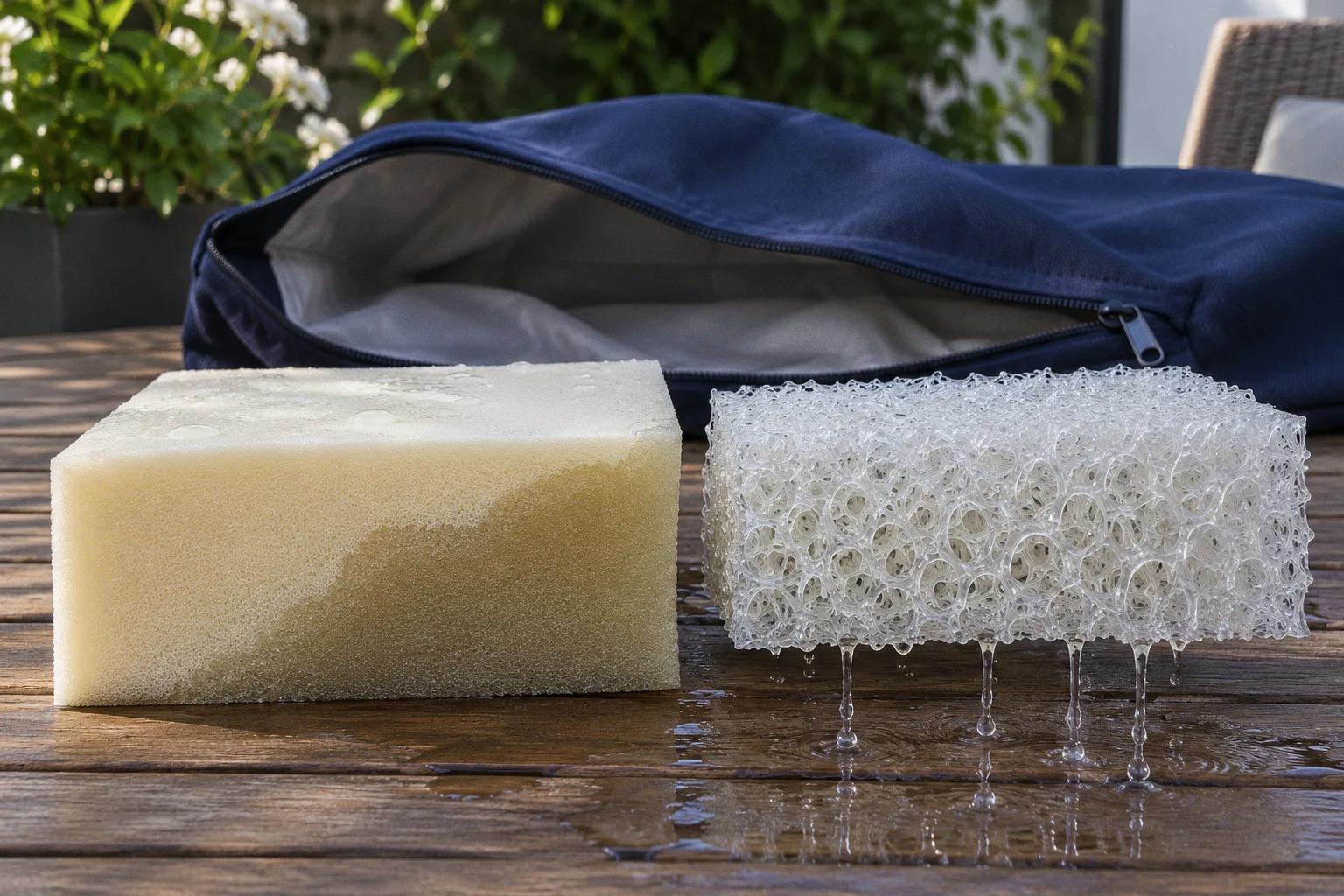
When cushions get wet, tip them on their side so the water runs out, rinse off dirt with a light hose, and leave them to dry in a ventilated place. Whatever foam you choose, ask what is inside any outdoor cushion before you order, ours included, and tell us where the cushions will sit.
Looking after outdoor covers
Routine cleaning is a mild soap in lukewarm water, a soft brush, a thorough rinse and air drying, the method Sunbrella gives for its solution-dyed acrylic. The same maker uses a bleach mixture for mould and mildew only; check the fabric's own care line first, because the care lines differ:
- Meridian: machine wash 30 °C, do not bleach, do not tumble dry.
- Siesta: machine wash 30 °C (gentle), chlorine bleach allowed, do not tumble dry.
- Lido: wash at 40 °C, do not bleach, do not tumble dry.
- Deckchair: machine wash 40 °C (gentle), bleach allowed, tumble dry low.
Brush off sand and dust before they work into the weave, and let a wet cover dry fully before it goes under a cover or into storage.
Outdoor sofa and cushion covers, made to measure
We make outdoor sofa covers and outdoor cushions to your measurements, in the outdoor fabrics above, and the season for them has started. At a free home visit our consultant brings the fabrics to your terrace to see in your own light, measures, and gives you a quote. Outdoor covers are priced at the visit.
You can also see an outdoor fabric on your own sofa photo in the room visualiser, or read how to choose sofa fabric for children, pets and sun indoors.
Sources
- Solution-dyed acrylic: colour and UV stabilisers added before the yarn is spun (Sunbrella)
- Acrylic performance fabric guide: UV and fade resistance of acrylic, polyester and olefin (Revolution Fabrics)
- UPF: what it means, UPF 50 blocks about 98%, the 50+ rating (Skin Cancer Foundation)
- ISO 105-B02: colour fastness to artificial light, xenon arc fading lamp test (Q-Lab summary)
- Testing materials for light fastness: the blue wool standards (SATRA)
- Water repellent or waterproof outdoor cushions, and why moisture in the foam is the problem (Microban)
- What is quick dry (reticulated) foam (Eco Outdoor)
- How to clean upholstery: soap, water, rinse, air dry; the bleach mixture for mildew (Sunbrella)
- Climate of Dubai: July and August highs, humidity and sunshine hours (Dubai Meteorological Office and NOAA data, as tabulated by Wikipedia)
Questions people ask
What is the best outdoor fabric for Dubai's sun?
A solution-dyed fabric with a light fastness of 7 or 8. Solution-dyed acrylic is the most fade resistant: our Meridian is graded 8 on the ISO 105-B02 scale and lists UPF 50+. Solution-dyed polyester, such as our Oasis (light fastness 7 to 8), is a strong second. Choose by the figures on each fabric's page, not by the name of the fibre alone.
Is solution-dyed acrylic better than polyester for outdoor cushions?
For fading, yes: acrylic is rated outstanding for UV and fade resistance, and solution-dyed acrylic carries its colour through the whole fibre. Polyester is dyed or printed on the surface unless it is also solution-dyed, as our Lido, Oasis, Mariner and Harbour are. Fibre alone doesn't settle it, so compare the light fastness of the fabrics you're choosing between.
What does UPF 50+ mean on an outdoor fabric?
UPF is the ultraviolet protection factor: how much of the sun's UV rays a fabric lets through. UPF 50 blocks about 98%, letting through 1/50th, and 50+ is the top rating. It was made for skin protection. For fading, look at light fastness. Some of our outdoor fabrics list a UPF figure, such as Meridian and Alfresco; others, such as Lido, don't.
Are outdoor fabrics waterproof?
Most are water repellent: water beads on the surface and runs off, and the fabric breathes. A few are waterproof, such as our Mariner (polyurethane coated) and Harbour (TPU coated). Waterproof is not always better for cushions, because moisture that does get in has nowhere to go, so the foam inside should drain.
How do you stop outdoor cushions going mouldy?
Keep them from staying wet. Use a breathable, water repellent fabric and quick-dry foam, which drains water through its open cells. Tip a wet cushion on its side to drain, let it dry in the air, and brush off dirt, which gives mould a hold. Our Meridian and Siesta are listed by their makers as mould resistant.
How do you clean outdoor cushion covers?
Follow the care line on the fabric, since they differ: Meridian says wash at 30 °C and do not bleach, while Siesta allows chlorine bleach. For routine cleaning, a mild soap in lukewarm water, a soft brush, a thorough rinse and air drying suit solution-dyed acrylic. Don't tumble dry covers whose care line says not to.
Does Reem Furnishings make outdoor sofa and cushion covers?
Yes. We make outdoor sofa covers and outdoor cushions to your measurements, in the outdoor fabrics in our catalogue. Our consultant brings the fabrics to your terrace at a free home visit, measures and gives you a quote. The price is confirmed at the visit.