Guide · Fabrics
Curtain and upholstery fabric in Dubai: where to buy it and how many metres
Fabric is sold by the metre, mostly about 140 cm wide, and the metres a job takes depend on that width, the fullness and the pattern. Here is how to work them out, and what to check before you buy.
The short answer
In Dubai, buy fabric by the metre and have a tailor or upholsterer make it up, or have a made-to-measure maker supply, make and fit it. For curtains, multiply the track width by the fullness (we use 2.5), divide by the fabric's width for the number of widths, and allow each the drop plus about 30 cm: a 200 × 250 cm window takes 11.2 m of plain 140 cm fabric. A three-seater sofa takes about 16 m.
- For curtains, track width × fullness ÷ fabric width gives the number of widths, each cut to the finished drop plus about 30 cm for the hem and heading.
- A 200 × 250 cm window at 2.5 times fullness takes 11.2 m of plain 140 cm fabric, or 13.44 m with a 64 cm pattern repeat.
- Extra-wide fabric, 280 cm or more, can be turned so its width becomes the drop: the same window takes about 5.2 m of 300 cm fabric, with no joins.
- In plain 140 cm fabric, makers list about 14 to 18 m for a sofa, 6 to 9 m for an armchair and 0.7 to 1.5 m for a dining chair.
- Buy all the fabric at once, from one batch, and see a sample in your own light before it is cut.
Buy fabric alone, or have it made to measure?
There are two ways to buy curtain and upholstery fabric in Dubai: by the metre, to be made up by a tailor or upholsterer you choose, or from a made-to-measure maker who supplies the fabric, makes the piece and fits it.
- By the metre gives you the widest choice and suits a simple piece, such as plain curtains or a chair seat. The metres are yours to work out, so ask whoever will make it up how much to buy first: makers' allowances differ, and if you buy short, the same batch may be gone.
- Made to measure puts the measuring, the metres, the cutting and the fitting with one maker, and the quote covers the fabric, making and fitting. It suits a whole room, a pattern that has to match across widths, and tall or wide glass.
We do both: fabric by the metre at our showroom in Al Karama, and curtains, blinds and upholstery made to measure from the same catalogue.
What to check before you buy
Whichever way you buy, check these on the label, the sample or the fabric's page:
- Width: about 140 cm for most fabric, and 280 cm or more for extra-wide curtain fabric.
- Composition: the fibres decide how a fabric hangs, creases and cleans; many curtain fabrics are dry clean only.
- Rub count, for upholstery: at least 25,000 rubs on the Martindale test for a family sofa, the British Standard's minimum for heavy domestic use. Sofa fabric for kids, pets and sun explains the numbers.
- Fire rating, where it's needed: a hotel or an office may ask for fabric tested to a fire standard, with its certificate, such as BS 5867 for curtains or BS 5852 for upholstered seating.
- Pattern repeat: the longer it is, the more fabric each cut wastes (below).
- Shrinkage, if the fabric will be washed: the makers of some of our upholstery fabrics allow up to 5% in a 30 °C wash, and 5% of a 250 cm drop is 12.5 cm.
- The batch: fabric is dyed in batches whose colour can differ slightly, so buy the whole quantity at once.
- Your own light: colours that match under one light can part under another, which colour scientists call metamerism. Look at a sample at home, by day and in the evening.
How many metres a curtain needs
A pair of curtains takes the track width times the fullness, in widths of fabric, each cut to the drop plus its hem and heading:
- Measure the track and the drop, as how to measure your windows shows.
- Multiply the track by the fullness. We make our curtains at about 2.5 times the track width; wave, pinch pleat or eyelet compares the headings.
- Divide by the fabric's width and round up. That is the number of widths, or drops, of fabric.
- Add the hem and heading to the drop. A guide published by the British Institute of Interior Design allows 15 cm for each, 30 cm in all.
- Round each cut up to whole pattern repeats, if there is a pattern, and add one repeat to place it.
- Multiply the widths by the cut.
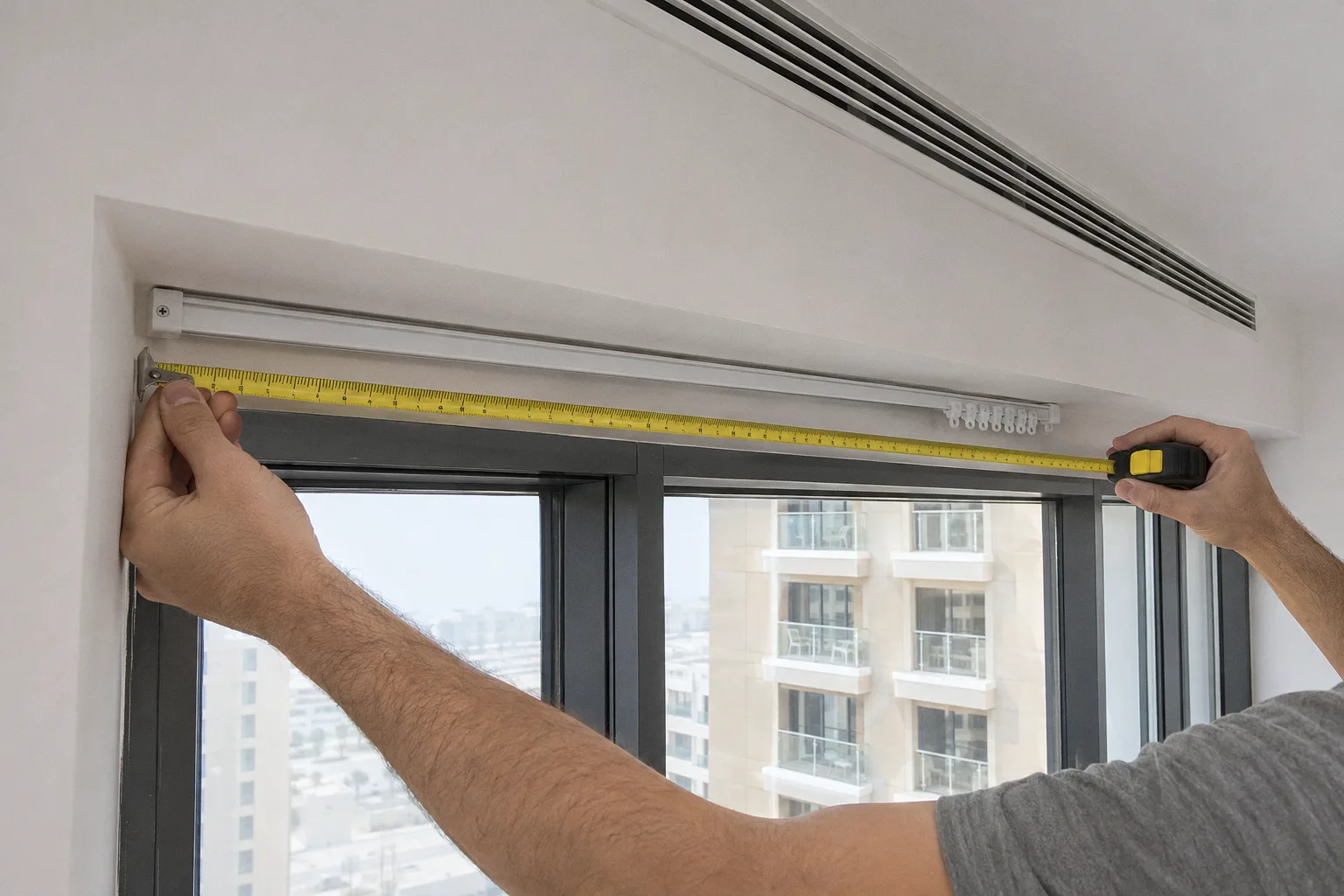
For a window 200 cm wide and 250 cm high, with a 200 cm track in a ceiling pocket and curtains to the floor:
| Plain, 140 cm wide | 140 cm wide, 64 cm pattern repeat | Extra wide, 300 cm, turned | |
|---|---|---|---|
| Fabric width for the pair | 200 × 2.5 = 500 cm | 500 cm | 500 cm, plus side hems |
| Widths of fabric | 500 ÷ 140 = 3.6, so 4 | 4 | One length, turned on its side |
| Each cut | 250 + 30 = 280 cm | 280 cm, rounded up to 5 repeats: 320 cm | The fabric's 300 cm width covers the 280 cm cut |
| Joins | 2, one in each curtain | 2, with the pattern matched | None |
| Fabric to buy | 4 × 280 cm = 11.2 m | 4 × 320 cm + 64 cm = 13.44 m | About 5.2 m |
The pattern adds 2.24 m, a fifth more, and a double curtain, a sheer behind a blackout, takes the sum once for each layer. Made and fitted by us, blackout curtains for a 200 × 250 cm window start from AED 630, and a blackout with a sheer from AED 1,020, fabric included (indicative, November 2026).
Pattern repeats: why a patterned fabric takes more
A pattern repeat is the length after which the design starts again down the fabric. Every width must start at the same point in it, so that the design runs on across the joins, and each cut is rounded up to whole repeats: our 280 cm cut becomes 320 cm with a 64 cm repeat, and would become 364 cm with a 91 cm one.
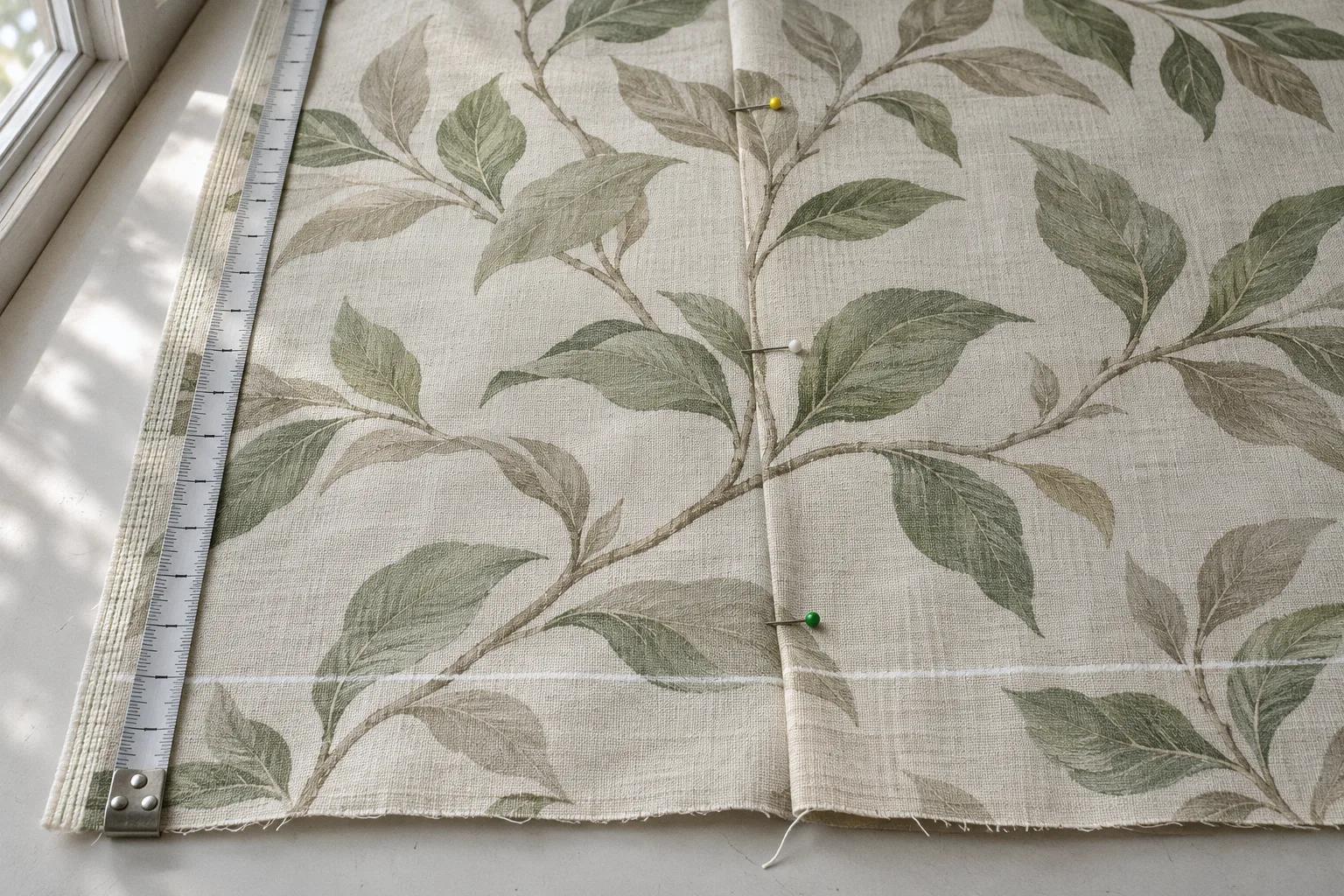
Check the repeat, which our fabric pages show as "Pattern repeat" wherever the maker gives it, and the match. In a half drop, every other repeat is dropped by half its length, which takes one more repeat on every other width.
Extra-wide fabric: curtains without joins
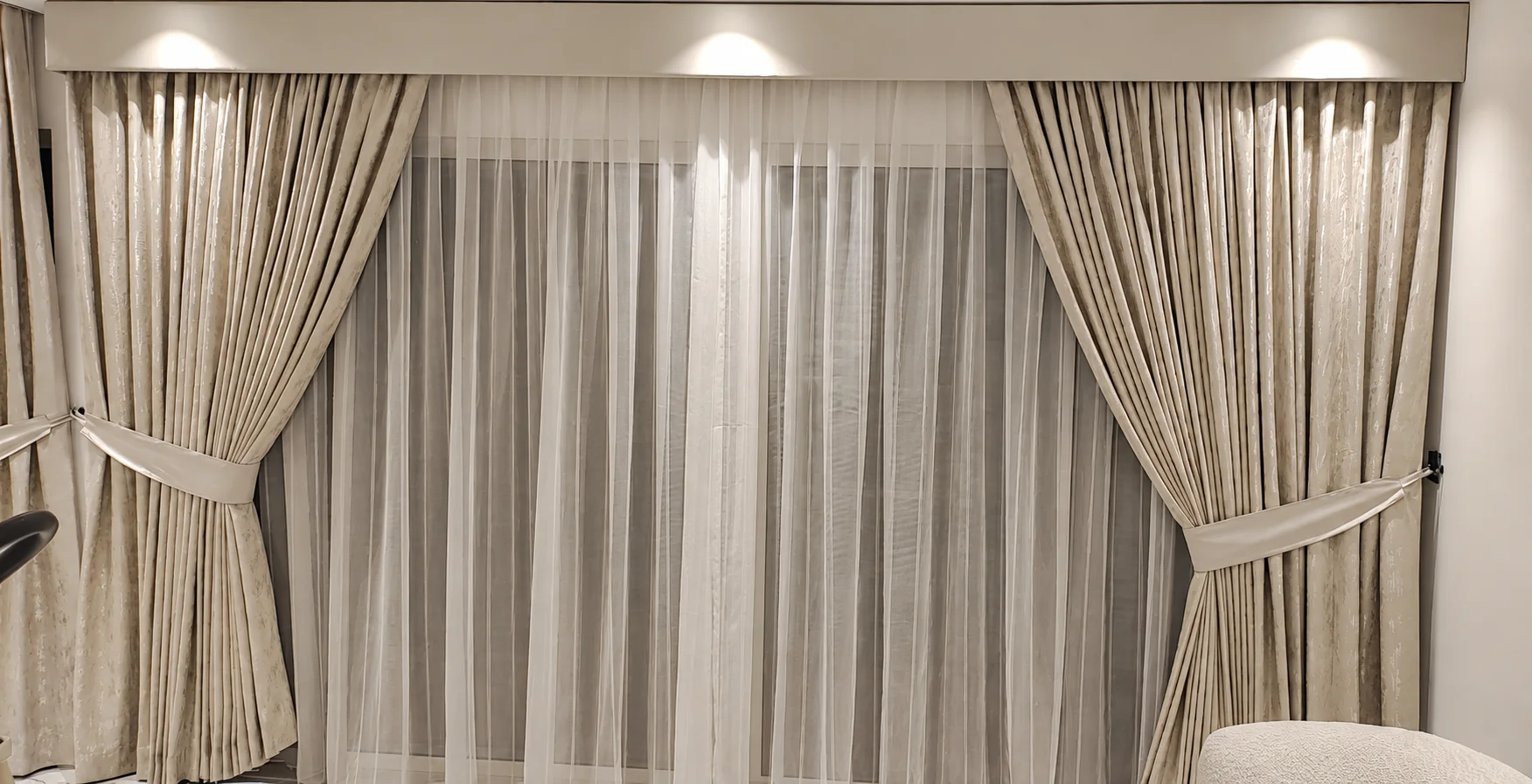
Extra-wide curtain fabric, 280 cm or more across, is woven about twice as wide as standard fabric and is often made to be used turned, with its design running across the roll. Its width then becomes the curtain's drop, so a curtain of any width needs no joins, as long as the drop with its hem and heading fits within the fabric's width:
- The drop: allowing 30 cm for the hem and heading, up to about 250 cm from 280 cm fabric, 270 cm from 300 cm and 290 cm from 320 cm.
- What you buy: the curtains' width rather than their drop, so our example window takes about 5.2 m of 300 cm fabric. Fewer metres doesn't always mean a lower price, so compare the cost of the curtain, not of the metre.
- The hem: some extra-wide sheers come with a lead band, a weighted edge that becomes the curtain's hem. Our fabric pages list it under "Hem".
- Taller glass: for a drop longer than the fabric is wide, as at a double-height window, a plain extra-wide fabric can be used up the roll like any other, with joins, though fewer of them.
In our catalogue, the blackouts are 300 or 320 cm wide and most sheers 290 to 360 cm, while velvets, embroidered fabrics and prints are about 140 cm wide.
How many metres a sofa or chair needs
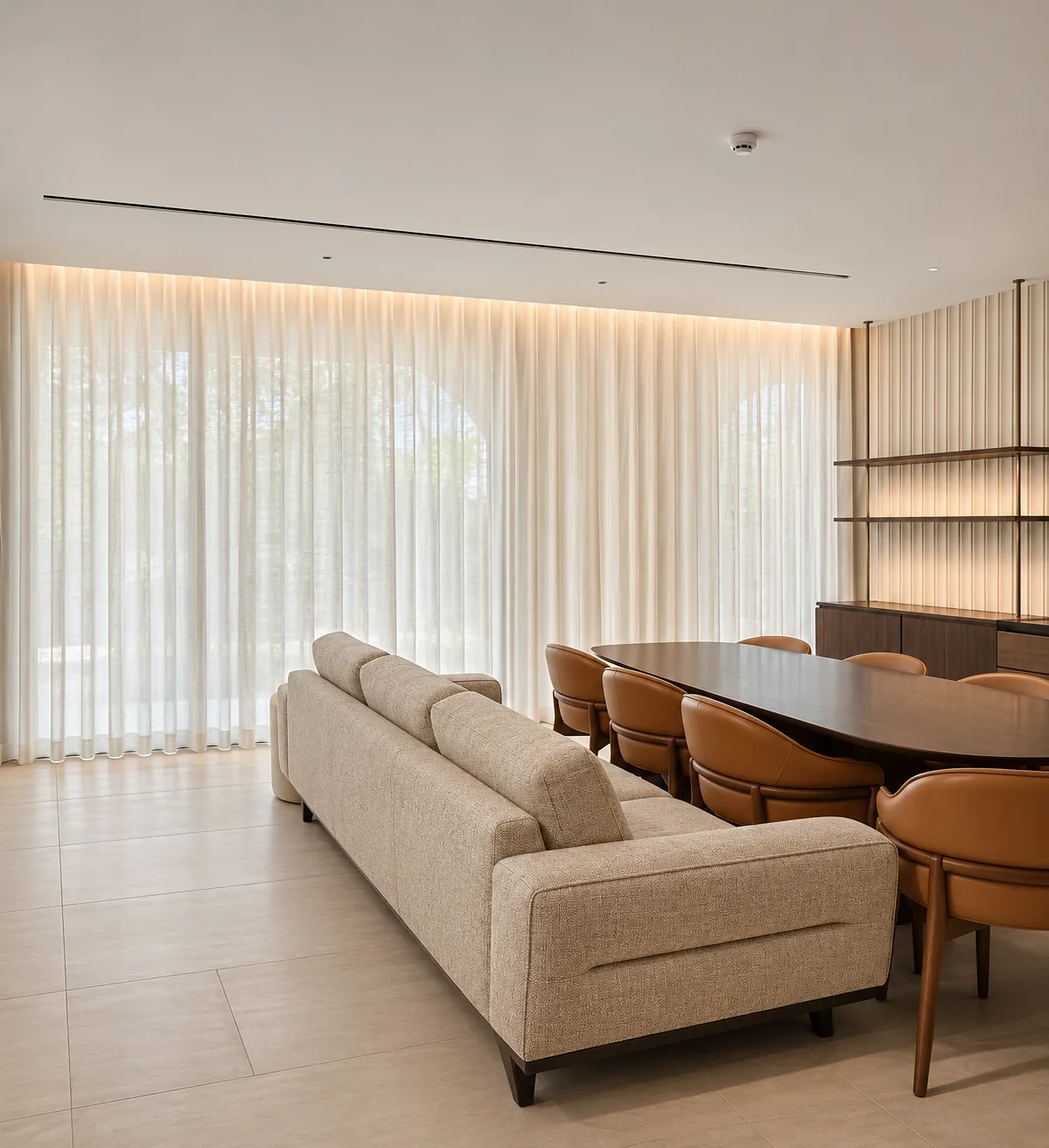
In plain fabric 140 cm wide, a sofa takes about 14 to 18 m, an armchair 6 to 9 m and a dining chair 0.7 to 1.5 m: more than their size suggests, because every panel, arm, cushion and border is cut separately. Makers list:
- Sofa: about 14 m for a two-seater, 16 m for a three-seater and 18 m for a four-seater, says a Spanish maker of upholstery fabrics; a US furniture maker lists 18.5 yards, about 16.9 m, of 137 cm plain fabric for a 208 cm two-seater.
- Armchair and dining chair: 6 to 9 m for an armchair; for a dining chair, 0.7 m with an upholstered seat and 1.5 m with the back upholstered too, from the same Spanish maker.
Then add 10 to 25% for a pattern, which is centred and matched across the pieces (one maker puts an 18-inch, 46 cm, repeat at about 20%), about 0.5 to 1 m for piping, and more for loose cushions, scatter cushions and a skirt.
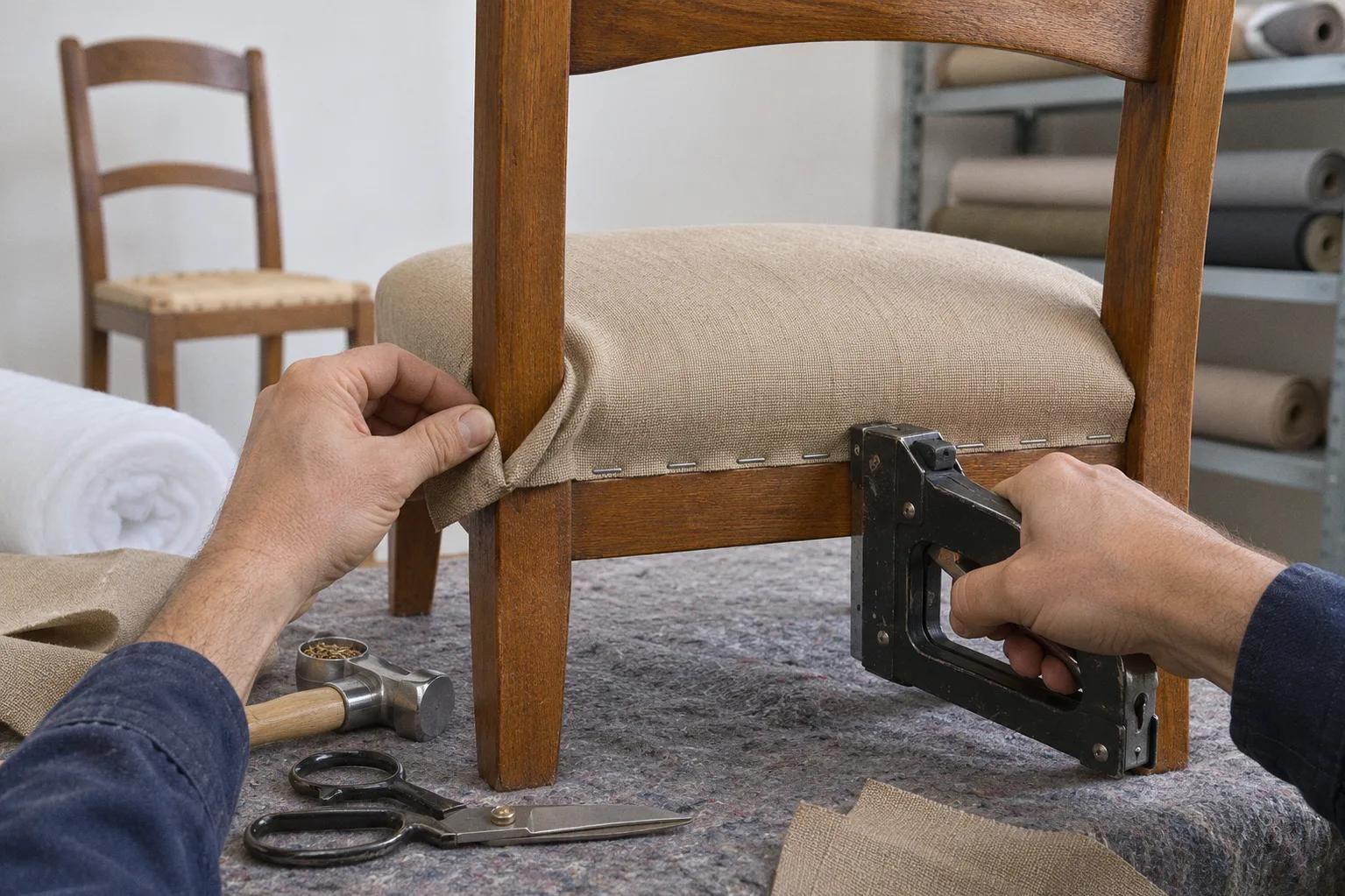
These are typical figures, not a quote: a deep corner sofa takes more, and a slim one less. At the free home visit, our consultant measures the piece and quotes for the fabric you choose. We make sofas to measure, usually in 10 to 15 days from the order, and re-cover sofas, armchairs and dining chairs whose frames are still good.
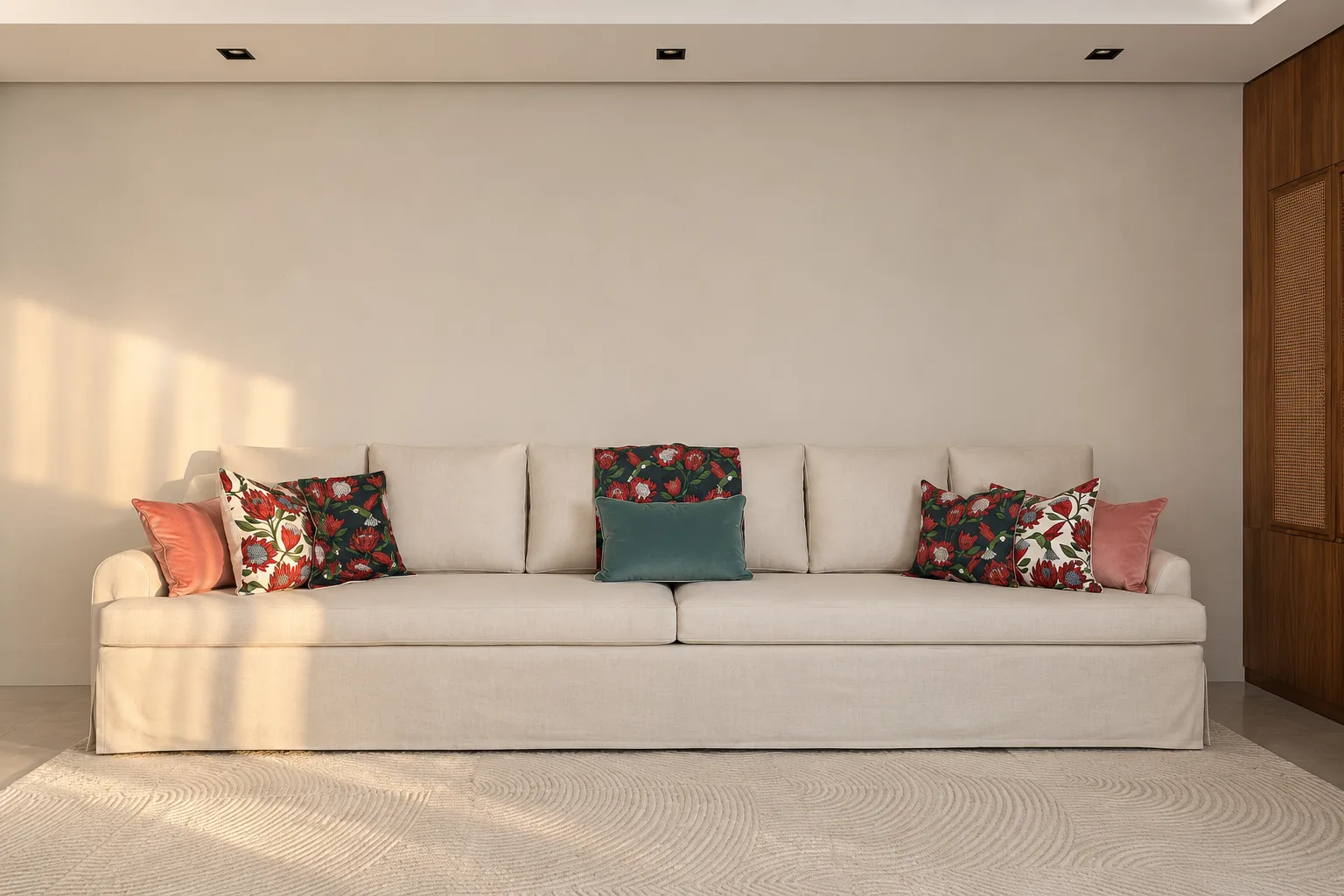
Our fabrics, by the metre or made to measure
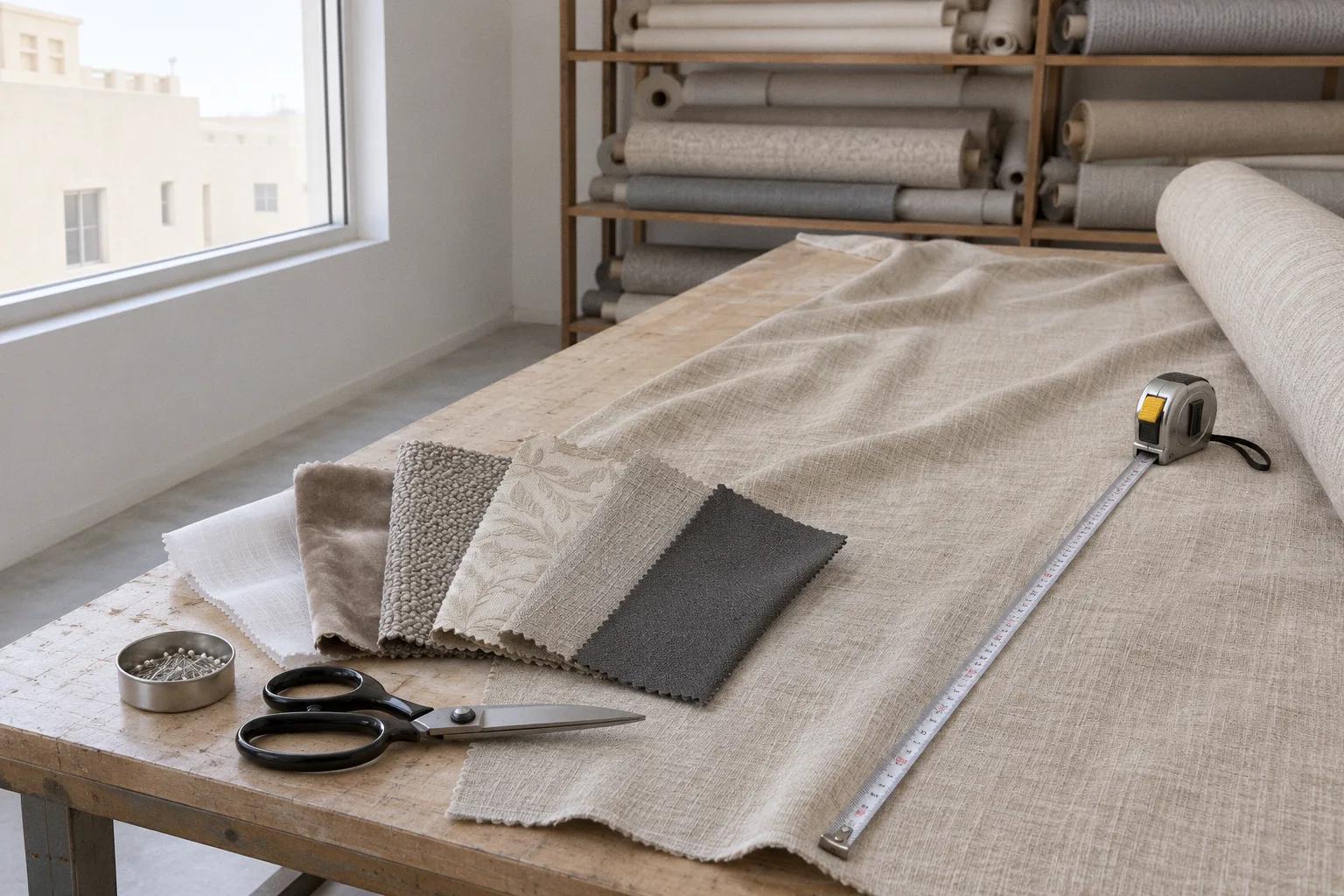
Our catalogue has more than 4,000 curtain and upholstery fabrics, each with the width, composition, pattern repeat, rub test, fire rating, hem and care its maker gives. Filter it by width, "Standard (about 140 cm)" or "Extra wide (280 cm and more)", or show fire-retardant fabrics only. These four show what to look for: a linen-blend sheer 320 cm wide with a lead band, a four-pass blackout 320 cm wide, an embroidered fabric 137 cm wide with its pattern repeat, and a plain upholstery fabric 140 cm wide, listed at 40,000+ rubs and tested to BS 5852.
- Ask about a fabric on WhatsApp or by email from its page, or save up to 12 to your shortlist and send them in one message. Every fabric is subject to availability.
- Buy by the metre at our showroom, 14 Mabrooka Building, Street 6A, Al Karama, open Monday to Saturday from 09:00 to 22:00 and on Sunday from 16:00 to 22:00.
- Or let us measure. At the free home visit, our consultant measures, brings swatches to see in your own light and gives you a quote for the fabric, making and fitting. Fabrics are priced at the visit.
Sources
- How to survey windows and calculate fabric: fullness, allowances and pattern repeats (Claire Tull and Michelle Gilder, BIID Knowledge Hub, 2019)
- Company FAQ: railroaded fabric, half-drop repeats and samples (Romo)
- Extra wide fabric: how it is made and used (De Le Cuona)
- How to calculate the fabric to upholster a sofa (aquaclean, August 2019)
- Emory sofas: yardage in 54-inch plain fabric (Kravet Furniture)
- Upholstery fabric calculator: pattern repeats and welting (Revolution Fabrics, August 2019)
- Flammability testing of curtains and drapes: BS 5867-2, types A, B and C (SATRA)
- BS 5852: ignitability of upholstered seating by smouldering and flaming ignition sources (BSI)
- BS 2543:2004 classification of upholstery fabrics, minimum rubs by end use, as printed in BTTG's abrasion test report 23/63242D/06/25 (July 2025)
- Lead times, cuttings and custom colour matching: dye lots (KOTHEA, 2026)
- What is metamerism? (Datacolor)
Questions people ask
How many metres of fabric do I need for curtains?
Multiply the track width by the fullness and divide by the fabric's width, rounding up: that is the number of widths. Multiply it by the cut, the finished drop plus about 30 cm for the hem and heading, rounded up to whole pattern repeats. For a 200 cm track and a 250 cm drop at 2.5 times fullness, that is 4 widths of 280 cm: 11.2 m of plain fabric 140 cm wide.
What does curtain fullness mean?
Fullness is how much wider the fabric is than the track before it is gathered into folds. We make our curtains at about 2.5 times the track width, so a 200 cm track takes 500 cm of fabric width. A guide published by the British Institute of Interior Design gives 2.5 for triple pleat, 2.2 for wave and eyelet, and 2.5 to 3 for sheers (voiles).
How much extra fabric does a patterned curtain need?
Every width has to start at the same point in the pattern, so each cut is rounded up to a whole number of vertical repeats, plus one repeat to place the pattern. With a 64 cm repeat, the 280 cm cuts in our example become 320 cm, and 11.2 m becomes 13.44 m. A half-drop pattern takes one more repeat on every other width.
What is extra-wide or railroaded curtain fabric?
It is fabric woven 280 cm or more wide, about twice the standard width, with its design running across the roll, so it is used turned on its side: the fabric's width becomes the curtain's drop, and the curtain needs no joins. Allowing about 30 cm for the hem and heading, 300 cm fabric takes a finished drop of up to about 270 cm, and 320 cm fabric up to about 290 cm.
How much fabric does a three-seater sofa need?
About 16 m of plain fabric 140 cm wide, according to one maker of upholstery fabrics; a US furniture maker lists 18.5 yards, about 16.9 m, of 137 cm plain fabric for a 208 cm two-seater. A pattern adds 10 to 25%, and piping, loose cushions and a skirt add more. Our consultant measures your sofa at the free home visit.
How much fabric does a dining chair need?
About 0.7 m of 140 cm fabric for a chair with an upholstered seat, and about 1.5 m when the back is upholstered too, according to one maker of upholstery fabrics. Buy for the whole set in one order, so every chair comes from the same batch.
Why buy all the fabric at once?
Fabric is dyed in batches, and the colour can differ slightly from one batch to the next, even in the same colourway. Buy the whole quantity in one order, with a little spare for repairs, so the curtains, cushions and sofa in a room match.
Can I buy fabric by the metre at Reem Furnishings?
Yes, at our showroom at 14 Mabrooka Building, Street 6A, Al Karama, Dubai, open Monday to Saturday from 09:00 to 22:00 and on Sunday from 16:00 to 22:00. Browse our fabric catalogue online first, save the fabrics you like to your shortlist and send it to us on WhatsApp or by email. Every fabric is subject to availability.