Guide · Sofas & Upholstery
Sofa fabric for kids, pets, spills and sun: what to choose in Dubai
A family sofa in Dubai faces four things: children, claws, spills and the sun through floor-to-ceiling glass. For each, the fabric's specification has something to check: rub count, weave, finish or light fastness.
The short answer
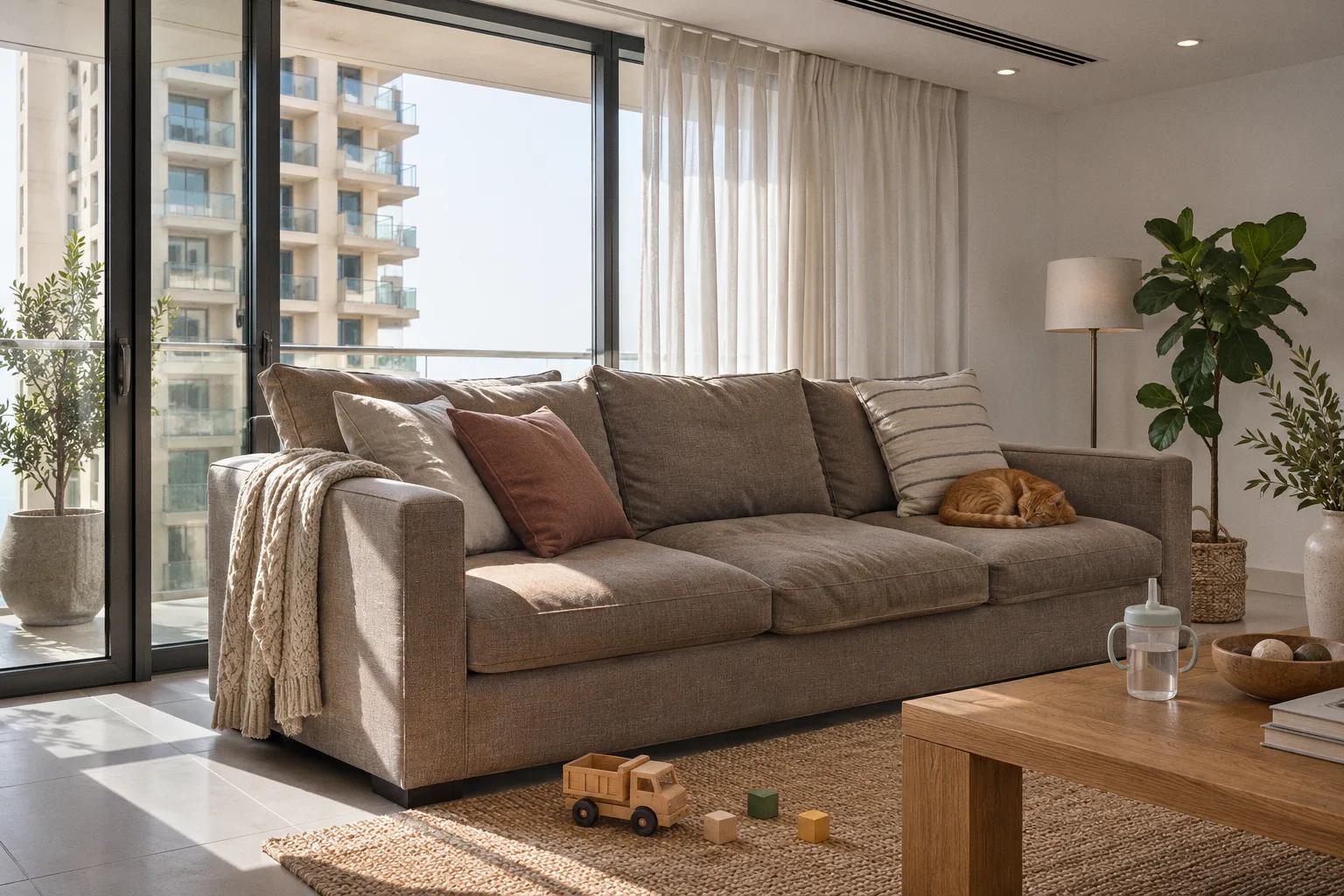
For a family sofa in Dubai, choose a tightly woven, stain-resistant fabric that can be cleaned with water and is rated at least 25,000 rubs on the Martindale test, the British Standard's minimum for heavy domestic use. With cats or dogs, avoid loops such as bouclé. If the sofa sits in direct sun, look for light fastness of 7 or 8 on the 1 to 8 blue wool scale. Faux leather wipes clean, but nothing is claw-proof.
- The British Standard (BS 2543) asks a flat-woven fabric for 20,000 rubs for general domestic use, 25,000 for heavy domestic and 40,000 for severe contract.
- Double the rubs is not double the life: above 100,000, a higher rub count says nothing more.
- Light fastness runs from 1 to 8, and each step takes about twice the light to fade; for a sofa in direct sun, look for 7 or 8.
- Claws catch loops and loose weaves. A tight, flat weave resists them, but no upholstery is claw-proof.
- Blot a spill, don't rub it, and clean only as the fabric's cleaning code or care label allows.
What to look for, by what your sofa faces
Children, pets, spills and sun each call for something different in a sofa fabric, and a fabric's specification lists most of it.
| What the sofa faces | What to look for | Our fabrics that list it |
|---|---|---|
| Children climbing and bouncing | 25,000 rubs or more on the Martindale test | Lounge, 40,000+; Salon, 25,000 to 70,000+ |
| Cats and dogs | A tight, flat weave with no loops | Saddlery faux leather, which its maker calls anti-scratch |
| Spills | A stain-resistant finish; cleans with water | Lounge, Nook, Salon, Heirloom and Alfresco |
| Sun through the glass | Light fastness 7 or 8 | Cosset, 7; Alfresco and Oasis, 7 to 8 |
No fabric is best at everything, so start with what your home meets most. The figures are the makers' own, shown on each fabric's page in our catalogue as "Rub test (Martindale)", "Light fastness" and "Finish" wherever the maker gives them.
The rub count: what the Martindale numbers mean
The Martindale rub count is how many rubs a fabric survives in a laboratory before its threads break, and a family sofa should have at least 25,000. In the test (ISO 12947-2), a disc of the fabric is rubbed against worsted wool under a set weight, in a looping pattern, until two threads break; the British Standard counts to three.
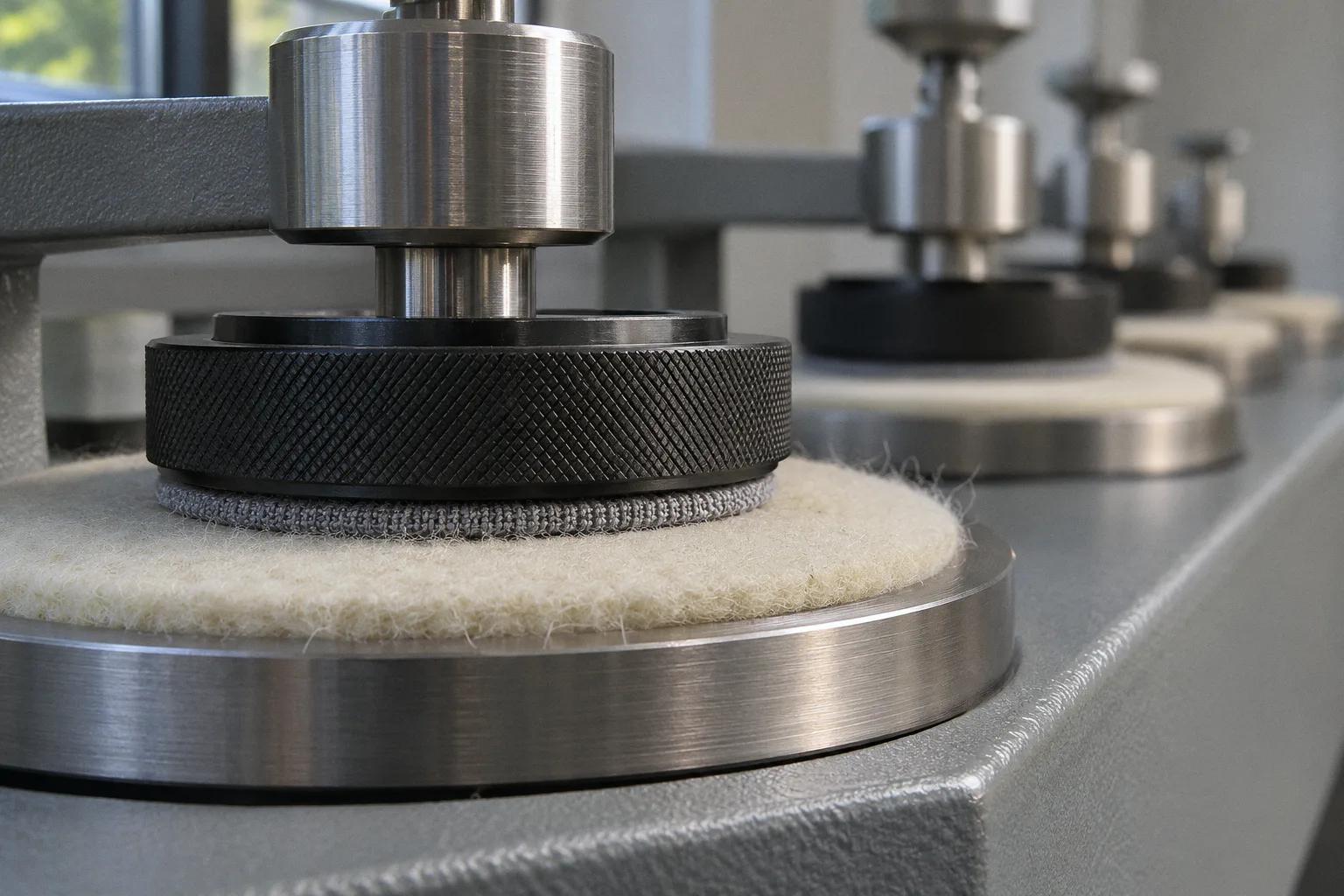
The British Standard for upholstery fabrics (BS 2543) sets these minimums for a flat-woven fabric; the bars differ a little for velvets and jacquards:
- Light domestic: 15,000 rubs
- General domestic: 20,000 rubs
- Heavy domestic: 25,000 rubs
- General contract: 30,000 rubs
- Severe contract, such as hotel and restaurant seating: 40,000 rubs
More rubs mean harder wearing, up to a point. One British maker of contract fabrics points out that double the rubs is not double the life, that results above 100,000 say nothing more about how long a fabric lasts, and that tests of the same fabric can vary widely. The rub test also leaves out snags, fading and pilling, which has its own test, graded from 1 (severe) to 5 (none). Furniture made for the US market is often rated in "double rubs" on another machine, the Wyzenbeek test, whose numbers can't be converted into Martindale rubs.
Cats and dogs: tight weaves, not loops
For a home with cats or dogs, choose a tight, flat weave: with the yarns lying flat, claws have nothing to hook into. Loops and loose weaves are the opposite, so keep bouclé, chenille and loose or heavily textured weaves away from a cat that sharpens its claws on the sofa.
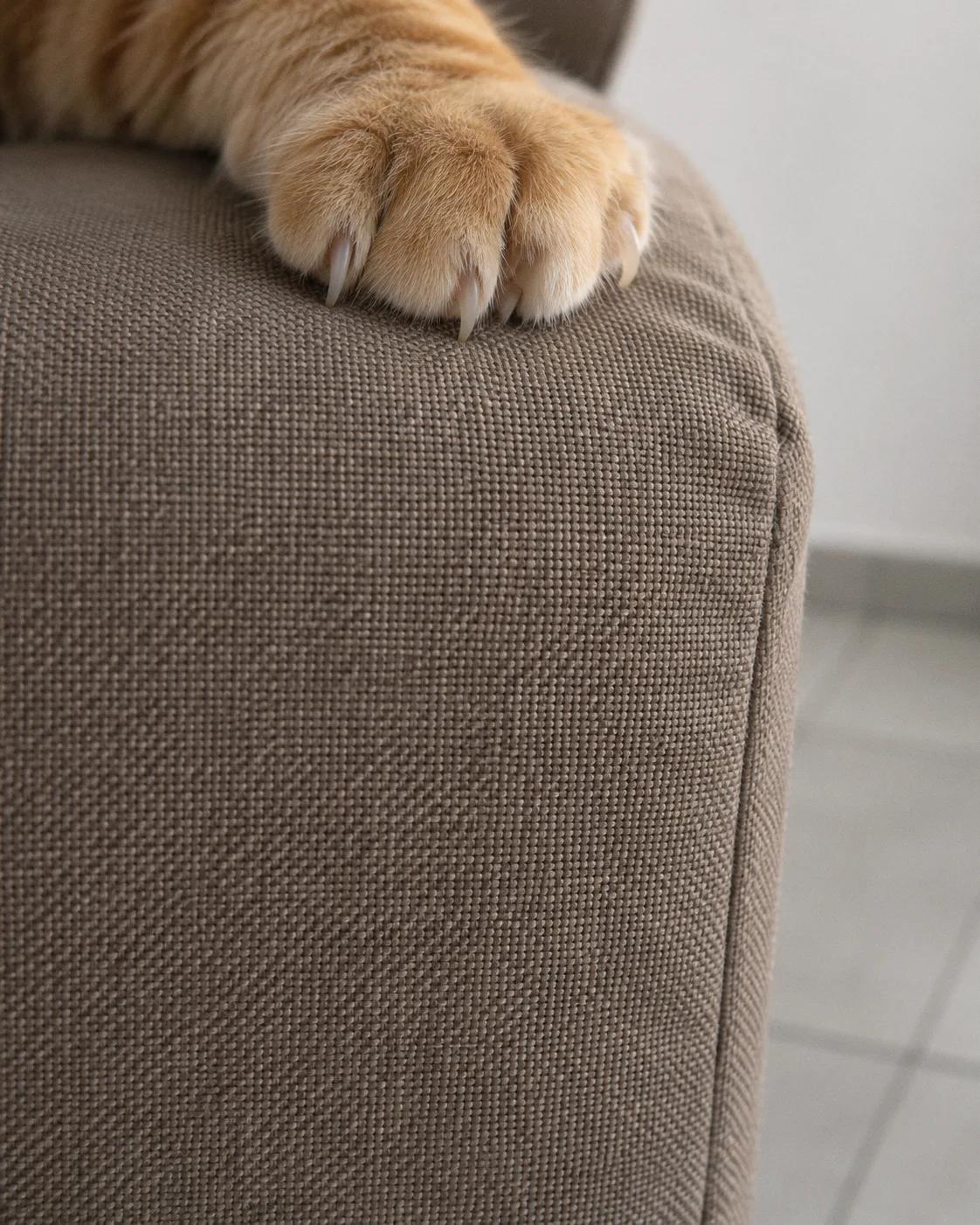
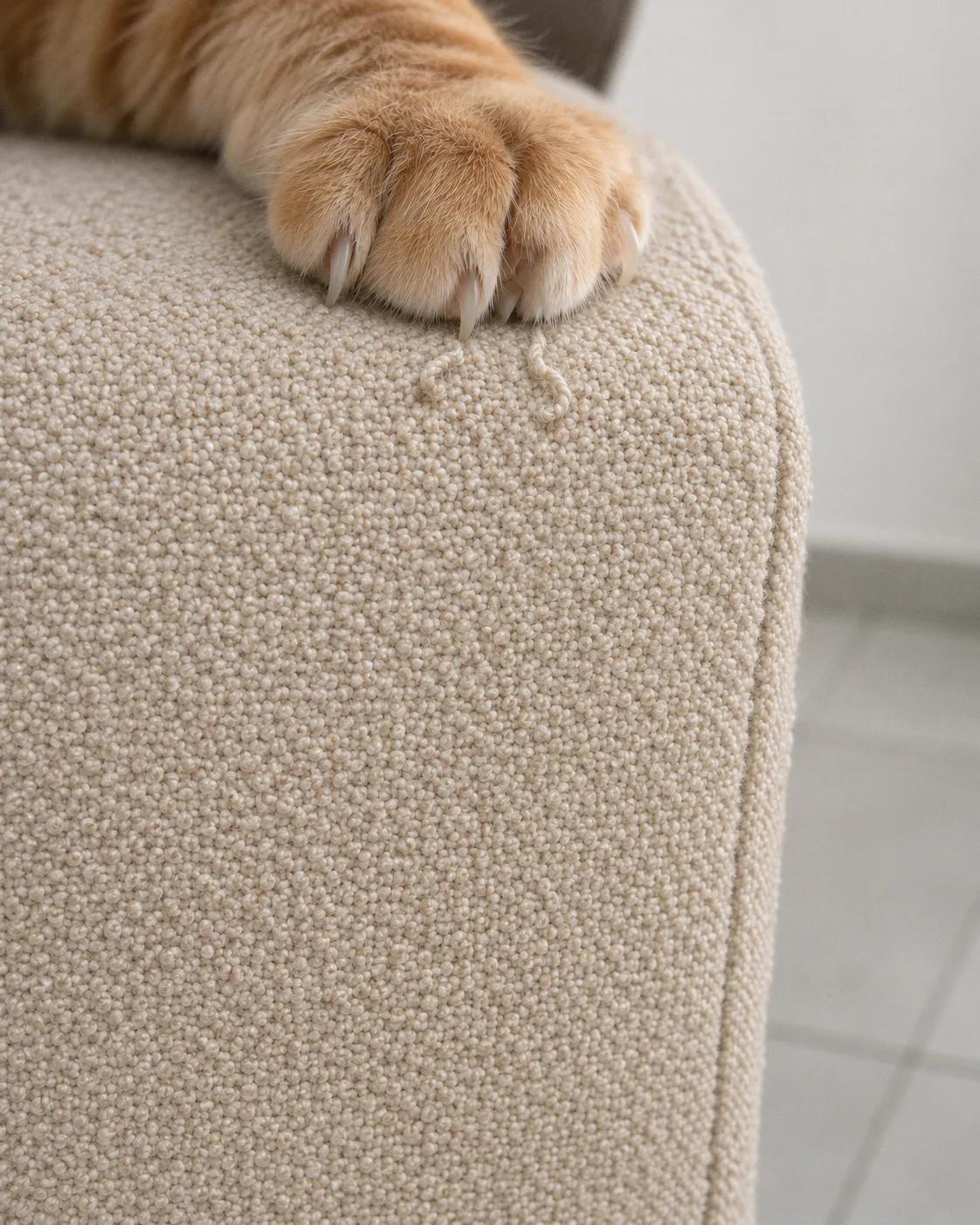
Bouclé, like this armchair's, is soft and in fashion: keep it for a room the cat doesn't use.
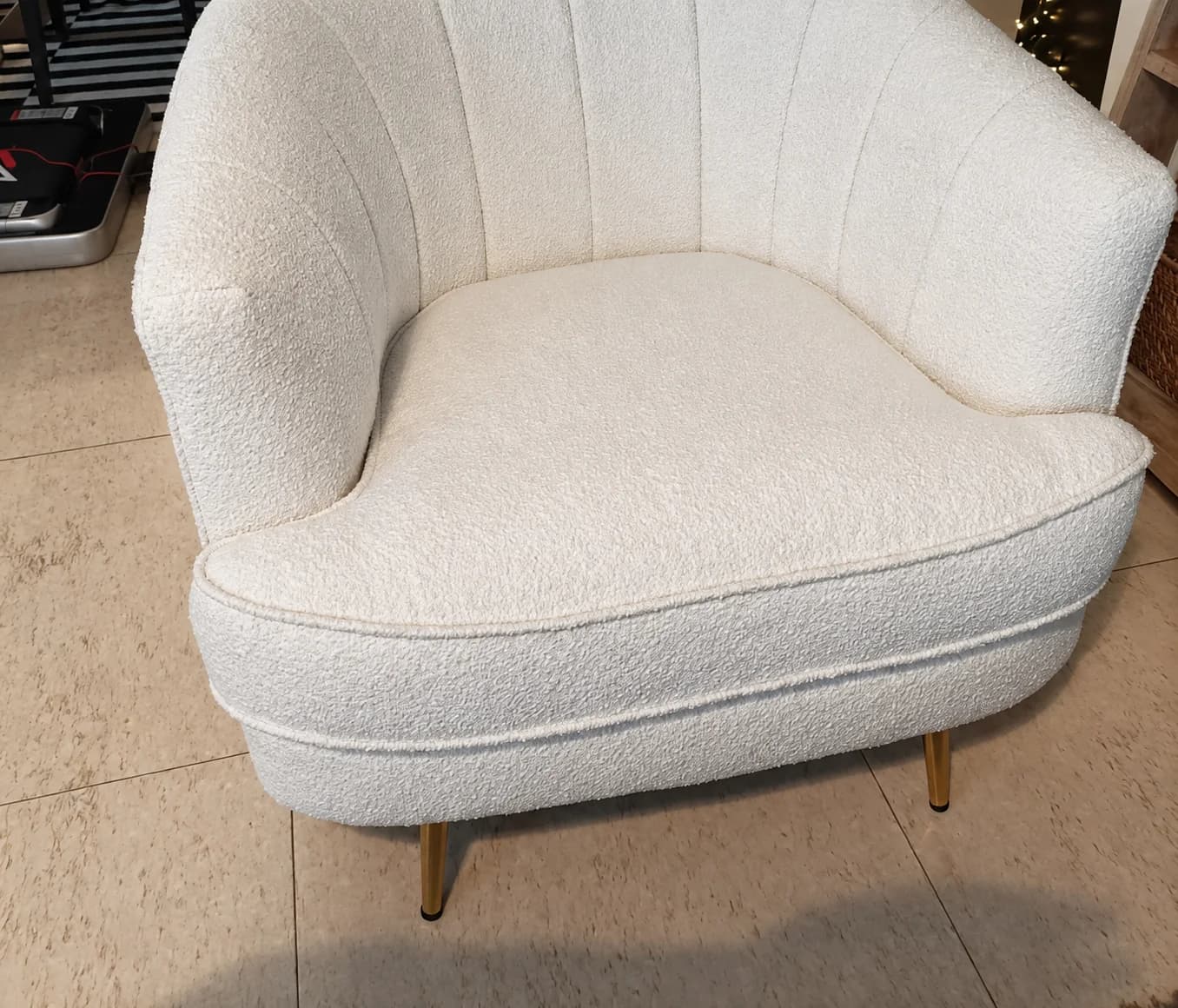
No upholstery is claw-proof, whatever the label says. Faux leather such as our Saddlery (RF-169), which its maker describes as anti-scratch, is made to resist scratches, but claws can still mark it. With dogs, a mid-toned fabric or a small pattern hides hair between cleans.
The surest help is somewhere else to scratch: a post tall enough for the cat to stretch to its full length, on a heavy base, next to the sofa and near where it sleeps, as Cats Protection, the UK cat charity, advises.
Spills: finishes, cleaning codes and removable covers
For spills, choose a stain-resistant or water-repellent finish: it helps a spill sit on the surface long enough to be blotted up. The maker lists our Lounge fabrics (RF-136), for example, as stain resistant, water resistant, ballpoint proof and cleanable with water alone. A finish buys time rather than making a fabric stain-proof, and it wears with rubbing and cleaning.
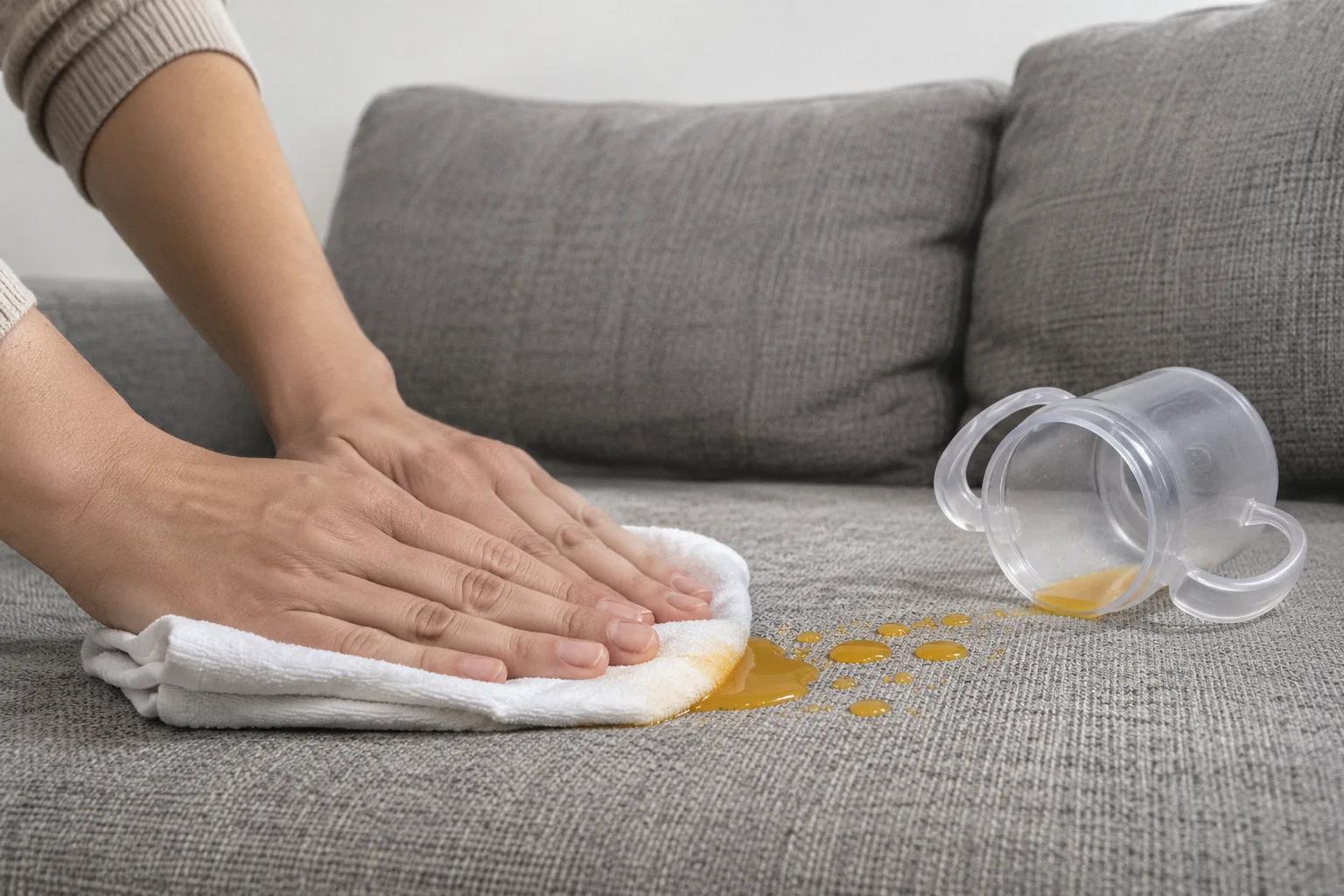
When something spills:
- Blot with a clean, dry white cloth. Rubbing pushes the spill in and spreads it.
- Lift grease with cornflour: sprinkle it on, leave it, then scrape it off with a straight edge.
- Clean as the fabric allows, testing any cleaner on a hidden spot first, then rinse out the soap and let the fabric dry in the air.
Many sofas carry a cleaning code under the cushions: W for water-based cleaners; S for solvent cleaners only, because water can shrink or mark the fabric; W/S for either, depending on the stain; and X for vacuuming or brushing only. Our fabric pages write the care out instead, such as "wash at 30 °C" or "dry clean (P)", where P means professional dry cleaning.
Removable covers help with children, but only if the fabric can be washed. Plan them before the sofa is made, wash every cover on the same programme so the colours stay even, line-dry them and put them back on while still slightly damp. Allow for shrinkage: the makers of some of our upholstery fabrics allow up to 5% in a 30 °C wash, which is 10 cm on a 2 m seat cover.
Sun at Dubai's windows: light fastness
Sun fades sofa fabric, and its light fastness, graded from 1 to 8, says how well it resists. In the test (ISO 105-B02), the fabric sits under a xenon lamp that imitates daylight beside eight blue wool references, and its grade is the reference that faded as much. Reference 1 fades fast and 8 hardly at all, and each takes about twice as much light to fade as the one before.
The light is what counts. Direct noon sun brings almost 100,000 lux, against about 5,000 near a window and 500 in most offices, says the Canadian Conservation Institute, and a sofa beside west-facing glass in Dubai can sit in direct sun for hours every afternoon. Fading adds up with brightness and time, and ultraviolet usually causes less than half of it, so glass that filters UV slows fading but doesn't stop it.
- Choose 5 at the least, the minimum one large Danish maker of upholstery fabrics accepts, and 7 or 8 for a sofa in direct sun, the grades conservators class as of low sensitivity to light.
- Look at fabrics made for sun. The makers list Cosset (RF-142) at 7, and Alfresco (RF-170) and Oasis (RF-177) at 7 to 8. Oasis is solution-dyed, its colour put into the fibre before it is spun, and its maker calls it pet friendly; at 20,000 rubs, it suits a sofa that gets more sun than wear.
- Draw a sheer in the sunny hours. It takes the direct sun off the sofa and keeps the view: blackout, dim-out or sheer compares them.
- Turn and swap loose cushions every few weeks, so they fade evenly.
Leather, faux leather or fabric?
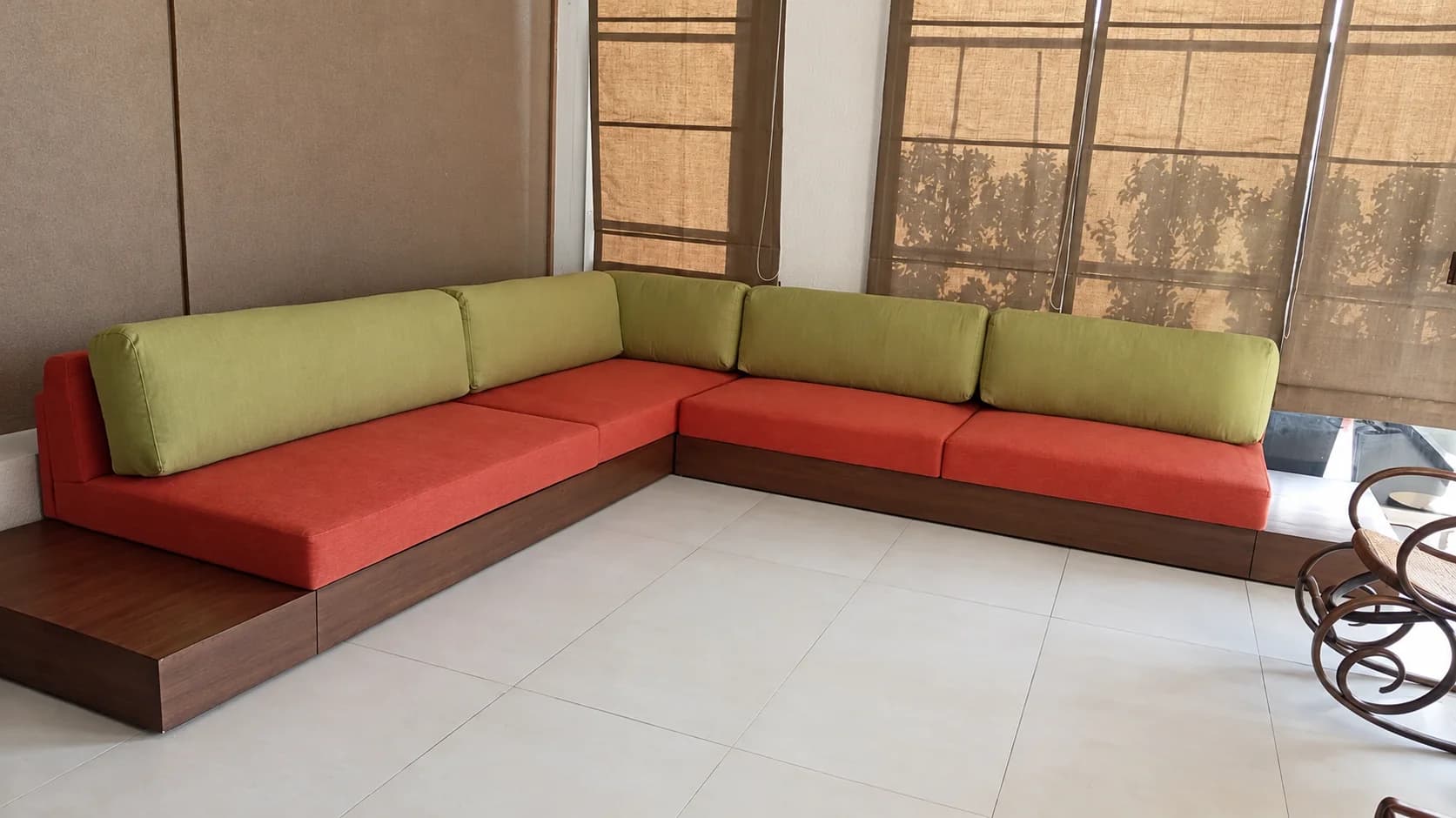
Leather and faux leather wipe clean, which helps with spills; fabric gives the widest choice of colour and feel, and can be re-covered when it wears.
- Leather: its finish matters most. Protected (pigmented) leather has a coating that better resists scratches, scuffs and fading, while aniline leather, with none, takes in spills and is more sensitive to sunlight. Claws can mark either.
- Faux leather: usually polyurethane on a fabric backing. Our Saddlery is 55% polyurethane and 45% polyester, listed by its maker at 30,000 rubs, and the maker of our Tannery faux leathers advises keeping them away from direct sun, damp, heat and sharp objects.
- Fabric: with the right rub count, weave, finish and light fastness, it handles children, pets and sun well.
Choosing your sofa fabric with us
Every fabric page in our catalogue lists the maker's rub test, light fastness, finish and care where the maker gives them. These four are listed at 25,000 rubs or more, and Alfresco and Cosset at a light fastness of 7 or more:
Our room visualiser shows one of our fabrics on a photo of your own sofa in about half a minute. At the free home visit, our consultant brings swatches to see in your own light and gives you a quote. We make sofas of every type to your measurements, usually in 10 to 15 days from your order, and re-cover sofas, armchairs and dining chairs whose frames are still good.
Sources
- BS 2543:2004 classification of upholstery fabrics, minimum rubs by end use, as printed in BTTG's abrasion test report 23/63242D/06/25 (July 2025)
- The abrasion debate: Martindale and Wyzenbeek testing explained (Camira, technical paper)
- Understanding key fabric performance indicators: abrasion, light fastness, pilling (Kvadrat)
- ISO 105-B02: colour fastness to artificial light, xenon arc fading lamp test (Q-Lab summary)
- Testing materials for light fastness: the blue wool standards (SATRA)
- Agent of deterioration: light, ultraviolet and infrared (Canadian Conservation Institute, Government of Canada)
- Best upholstery fabric for cats: why the weave matters (Revolution Fabrics, June 2026)
- Pet friendly fabric guide (Bemz)
- Scratching: why cats scratch and how to choose a scratching post (Cats Protection)
- Cleaning codes W, S, SW, WS and X (HBF Textiles)
- Care symbols: washing temperatures and professional cleaning (GINETEX, ISO 3758)
- How to clean upholstery: blot, don't rub (Sunbrella)
- Solution-dyed fibres: colour added before the yarn is spun (Sunbrella)
- How to take care of your cover: washing removable covers (Bemz)
- Upholstery glossary: aniline, semi-aniline and protected leather (American Leather)
Questions people ask
What Martindale rub count does a family sofa need?
At least 25,000 rubs, the British Standard's minimum for heavy domestic use for a flat-woven upholstery fabric (BS 2543). The same standard sets 20,000 for general domestic use and 40,000 for severe contract use, such as hotel seating. Above about 100,000 rubs, a higher number no longer predicts a longer life.
Is 40,000 rubs good for a sofa?
Yes. 40,000 rubs is the British Standard's minimum for severe contract use, so on wear alone it is more than a home needs. Our Lounge upholstery fabrics, for example, are listed at 40,000 rubs or more. Check the weave and the finish too, since the rub test doesn't measure snags, stains or fading.
What does light fastness 7 mean on a fabric?
Light fastness is graded from 1 to 8 against eight blue wool references (ISO 105-B02). A fabric graded 7 faded about as much as reference 7, and each reference takes roughly twice as much light to fade as the one before it. Conservators class grades 7 and 8 as of low sensitivity to light, so a 7 suits a sofa that gets sun, though no fabric is fade-proof.
What is the best sofa fabric if you have cats?
A tight, flat weave, where claws have no loops or loose threads to catch: avoid bouclé, chenille and loose or heavily textured weaves. Faux leather such as our Saddlery, which its maker describes as anti-scratch, resists scratches, but no upholstery is claw-proof, so give the cat a tall, sturdy scratching post next to the sofa.
Is faux leather good for a sofa with children and pets?
It wipes clean, which suits spills, and its maker lists our Saddlery faux leather at 30,000 rubs on the Martindale test. Claws can still mark it, and the maker of our Tannery faux leathers advises keeping them away from direct sun, damp, heat and sharp objects, so keep a faux leather sofa out of the afternoon sun.
What do the cleaning codes W, S, W/S and X mean?
They are the cleaning codes on many sofas' labels. W means water-based cleaners; S means solvent cleaners only, because water can shrink or mark the fabric; W/S means either, depending on the stain; X means vacuuming or brushing only. Many fabric books print care symbols instead, such as a wash tub with the highest washing temperature.
Can you wash removable sofa covers?
Only if the fabric's care label allows washing. Wash every cover on the same programme so the colours stay even, line-dry them and put them back on while still slightly damp. Allow for shrinkage: the makers of some of our upholstery fabrics allow up to 5% in a 30 °C wash, which is 10 cm on a 2 m cover.
How long does a new sofa take in Dubai?
Ours usually take 10 to 15 days from your order, made to your measurements in the fabric you choose. If the frame of your sofa is still good, we can re-cover it in a new fabric instead. Both are priced at the free home visit.