Guide · Curtains
West-facing windows in Dubai: what cuts the afternoon heat?
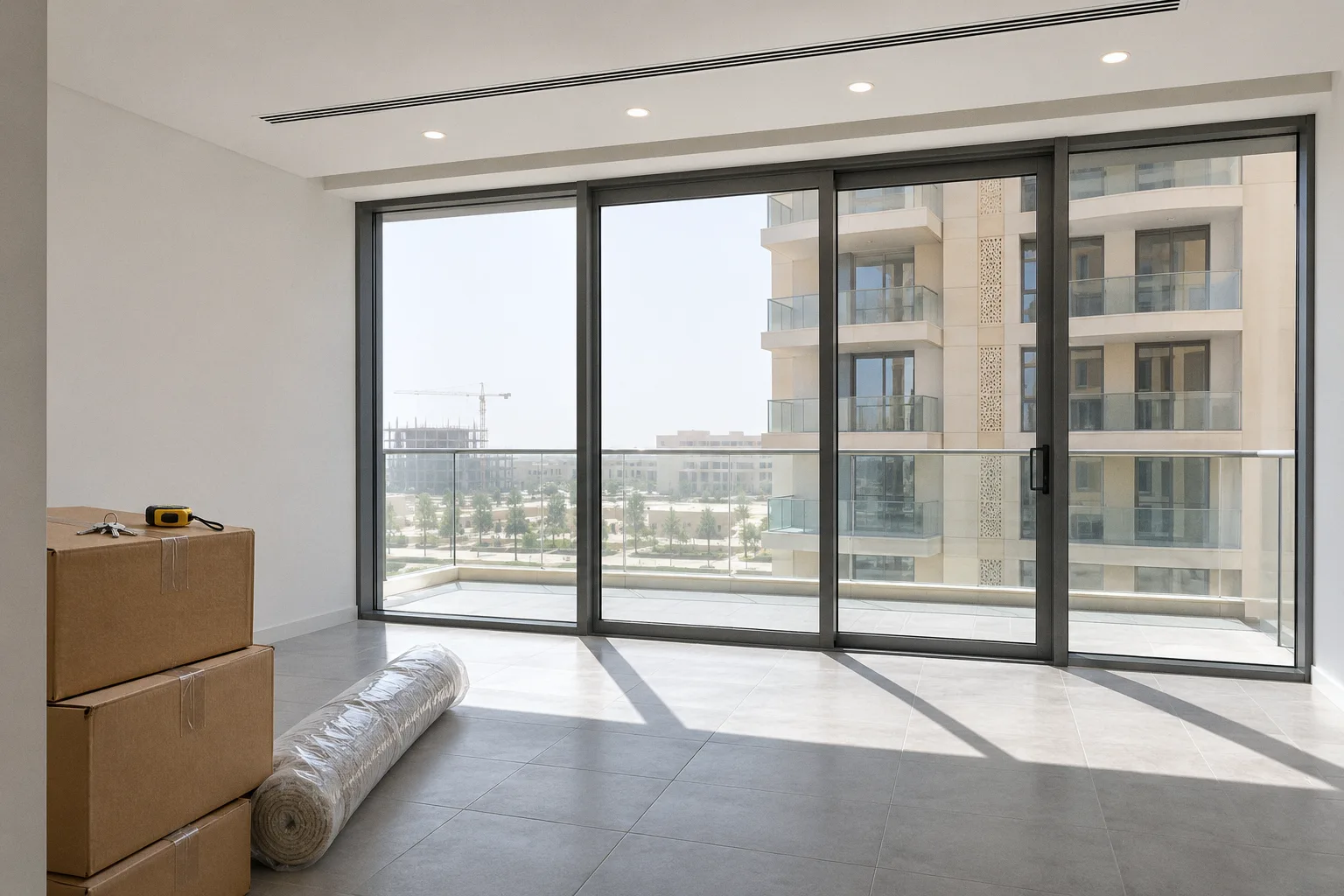
In the afternoon the sun hits west glass square-on, in the hottest hours of the day. A curtain or blind works after the heat has passed the glass, so what you choose and how it fits matter.
The short answer
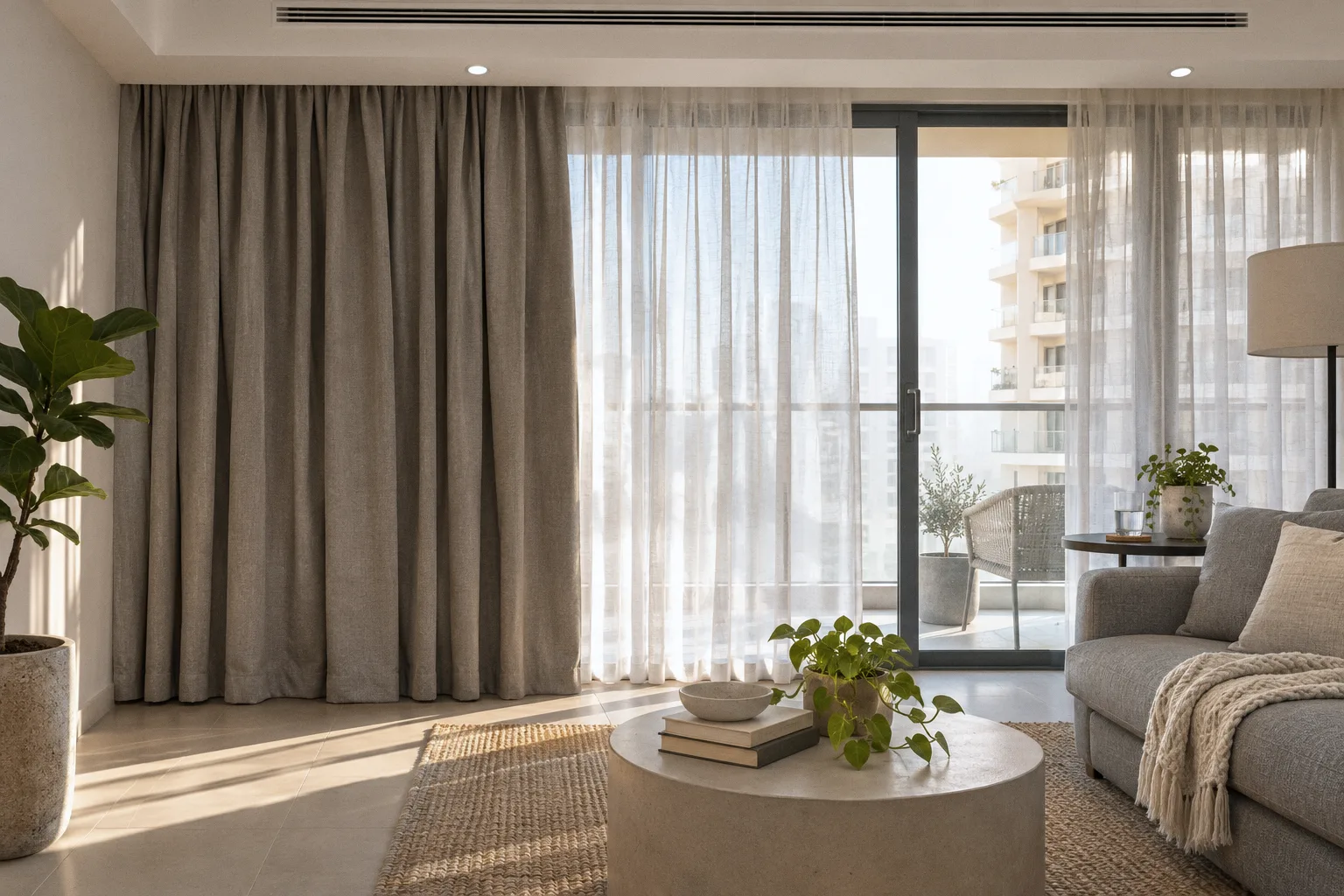
The most heat is cut by shading a west-facing window outside the glass, such as an awning, which a tower flat rarely allows. Inside, close a lined curtain with a light or white back before the sun reaches the glass, or a roller blind in a low-openness screen fabric. Sheers soften glare, but cut little heat: a fine net curtain stops about a quarter.
- Ordinary glass lets most of the sun's heat in: a solar heat gain coefficient of about 0.81 for clear single glazing and 0.72 for clear double glazing.
- Shading outside works best: awnings cut summer heat gain by up to 77% on west windows. A curtain inside acts only after the sun has passed the glass.
- A lined curtain with a white or light back cuts heat gain by about a third; a fine net curtain, by about a quarter.
- DEWA advises keeping blinds and curtains closed to reflect heat away from the house, and opening them in the late afternoon or early evening.
Why does a west-facing window get so hot in the afternoon?
A west-facing window gets so hot because the afternoon sun hits the glass almost head-on, for hours, in the hottest part of the day. In June, Dubai's noon sun is nearly overhead (88.2° high at 12:20 pm), so a window facing south sees little of it. Through the afternoon the sun swings west, and on 21 June it sets at 7:11 pm, in the west-northwest (297°).
The Australian government's Your Home guide describes the geometry: on a summer afternoon the sun meets a west-facing window at an angle of incidence between about 0° and 30°, which is nearly square-on, so the glass passes more heat than a north-facing one. That low sun also gets round overhangs and balcony slabs, which work against sun that is high in the sky. The guide says low afternoon summer sun from the west is more difficult to shade. In the United States, unshaded east and west windows receive up to twice the solar heat of a south window in midsummer (Pacific Northwest National Laboratory, for US latitudes, not Dubai's).
How much of the sun's heat does the glass let in?
Most of it, unless the glass is coated or tinted. The figure is the solar heat gain coefficient (SHGC): the share of the sun's heat that gets through a window, from 0 to 1.
| Glass | SHGC |
|---|---|
| Clear single glazing, aluminium frame | 0.81 |
| Clear double glazing | 0.72 |
| Tinted single glazing | 0.65 |
| Tinted double glazing | about 0.36 to 0.57 |
| Coated double glazing | about 0.22 to 0.60 |
These are Australian building-code reference values; the ranges are indicative. An older shading coefficient (SC) compares a glass with 3 mm clear float glass, and SHGC is roughly SC × 0.87. Glass varies from building to building, which is why the same afternoon feels different from flat to flat. If yours is clear, a covering has the most to do. A window film can halve a window's SHGC (Your Home), but it is a separate job from a curtain or blind.
Inside or outside: what a curtain or blind can and cannot do
A curtain or blind can only act on the heat after it has passed through the glass. Exterior shading blocks the sun first. The US Department of Energy says window awnings can cut summer solar heat gain by up to 65% on south-facing windows and 77% on west-facing ones, and BuildingGreen puts exterior roller shades at up to 85%. Interior curtains and drapes block 20% to 60%, depending on the fabric and colour. In a tower flat, the facade is the building's, so the question is how well the inside does its part.
An interior covering helps in three ways:
- It reflects. A pale or white face turned to the glass sends part of the sun back out through the window.
- It absorbs the rest in the fabric, and part of that warms the room anyway, which is why a pale face matters more than a dark one.
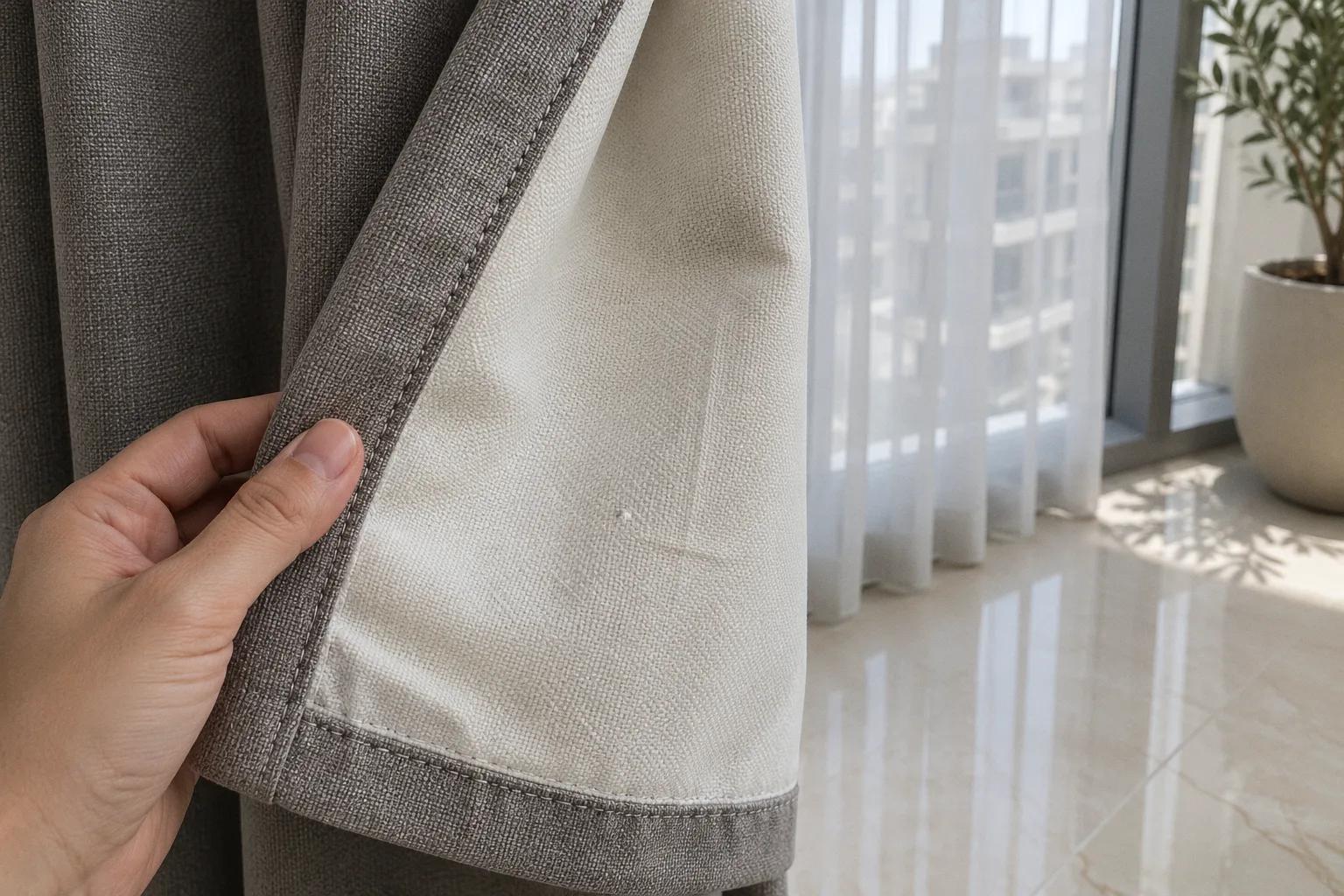
- It closes the gaps. A covering that fits close to the glass, from the ceiling track to just above the floor, with no light at the edges, leaves the sun nowhere to go round it. Your Home recommends snug-fitting curtains with a pelmet, to trap a layer of still air next to the window.
What each covering does for heat and glare
For heat, a lined curtain or a closed blind with a light face does the most inside; sheers do the least. The table gives published shading coefficients for closed coverings on clear glass: the lower the number, the less heat gets in (1 means bare glass).
| Covering | Heat let in, against bare clear glass | Glare and view | One window, 200 × 250 cm |
|---|---|---|---|
| Sheer curtain | 0.76 (fine net) to 0.85 (open weave): a cut of 15% to 24% | Softens glare, keeps the view and daylight | From AED 450 |
| Lined or blackout curtain | 0.49 for a closed light curtain, 0.54 for white cotton; the US Department of Energy says about a third less for medium colours with a white backing | Stops glare; the room goes dark or dim | From AED 630 |
| Roller blind in a screen fabric | Depends on the fabric's openness (1% to 10%): the lower the figure, the less glare and heat get in | Cuts glare, keeps some view | From AED 550 |
| Blackout roller blind | We found no published figure; a light face reflects more | Stops all light | From AED 550 |
| Zebra (day and night) blind | We found no published figure; the sheer bands let sun in when lined up | Light or privacy; dims rather than darkens | Priced at the visit |
The coefficients come from British test data (BRE and ETSU) for closed coverings on clear glass, so read them as a ranking, not a promise. A cream linen blind scored 0.40 and a closed Venetian blind 0.56 in the same tables. Makers add that dark screen fabrics cut glare best and keep the clearest view, while light ones reflect more of the sun's heat. Prices are indicative, from our price guide, and include the fabric, making and standard fitting (November 2026).
What we would put on a west window
We would put a double layer on the glass, with a motor on a timer where the window is large. Our guides to blackout, dim-out and sheer curtains and roller, zebra or Roman blinds cover each type in more detail.
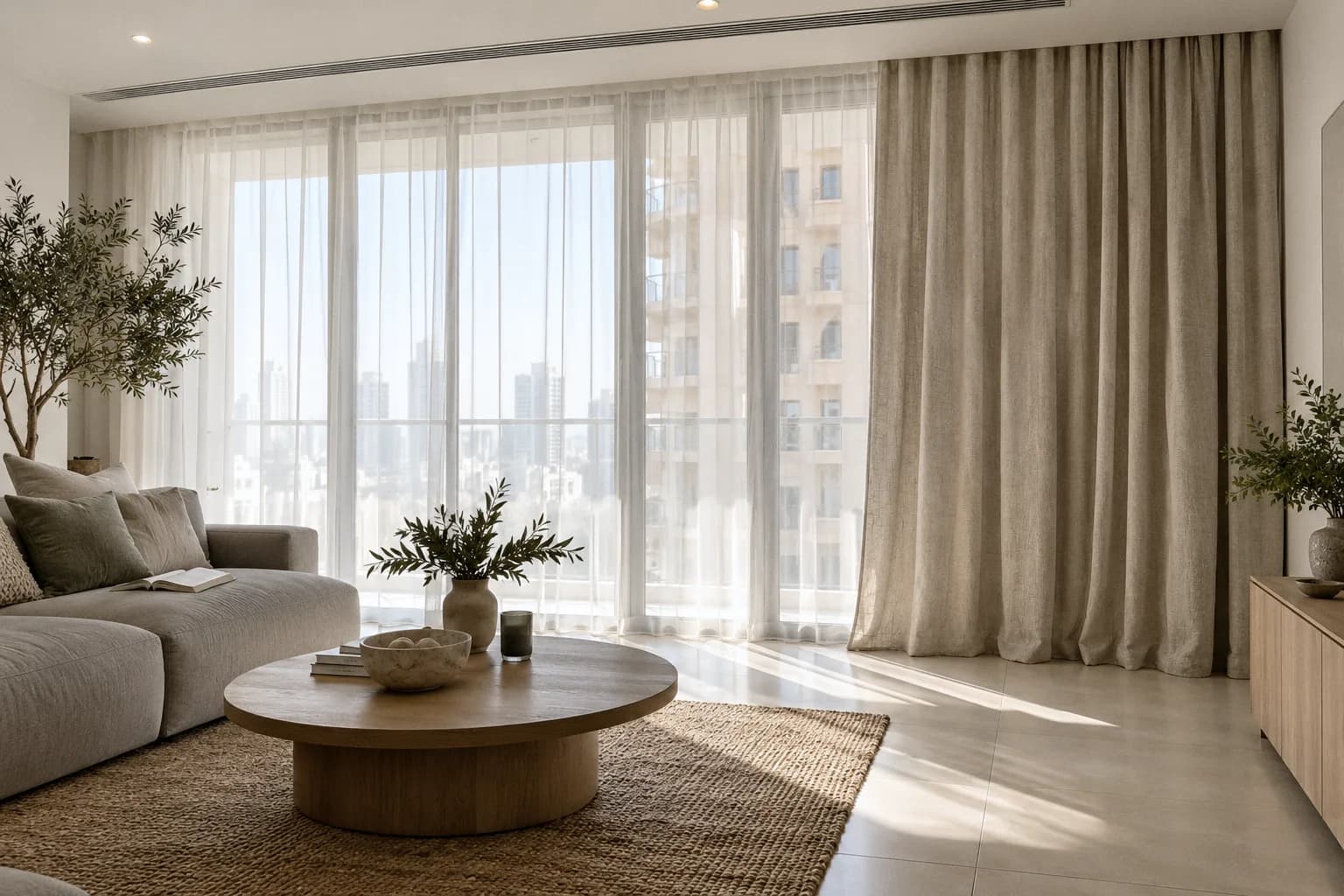
- A living room with a wall of glass: off-white sheers for the glare through the morning and early afternoon, with a lined curtain, light on the glass side, drawn across before the sun reaches the glass. Blackout and sheer curtains start at AED 1,020 (indicative).
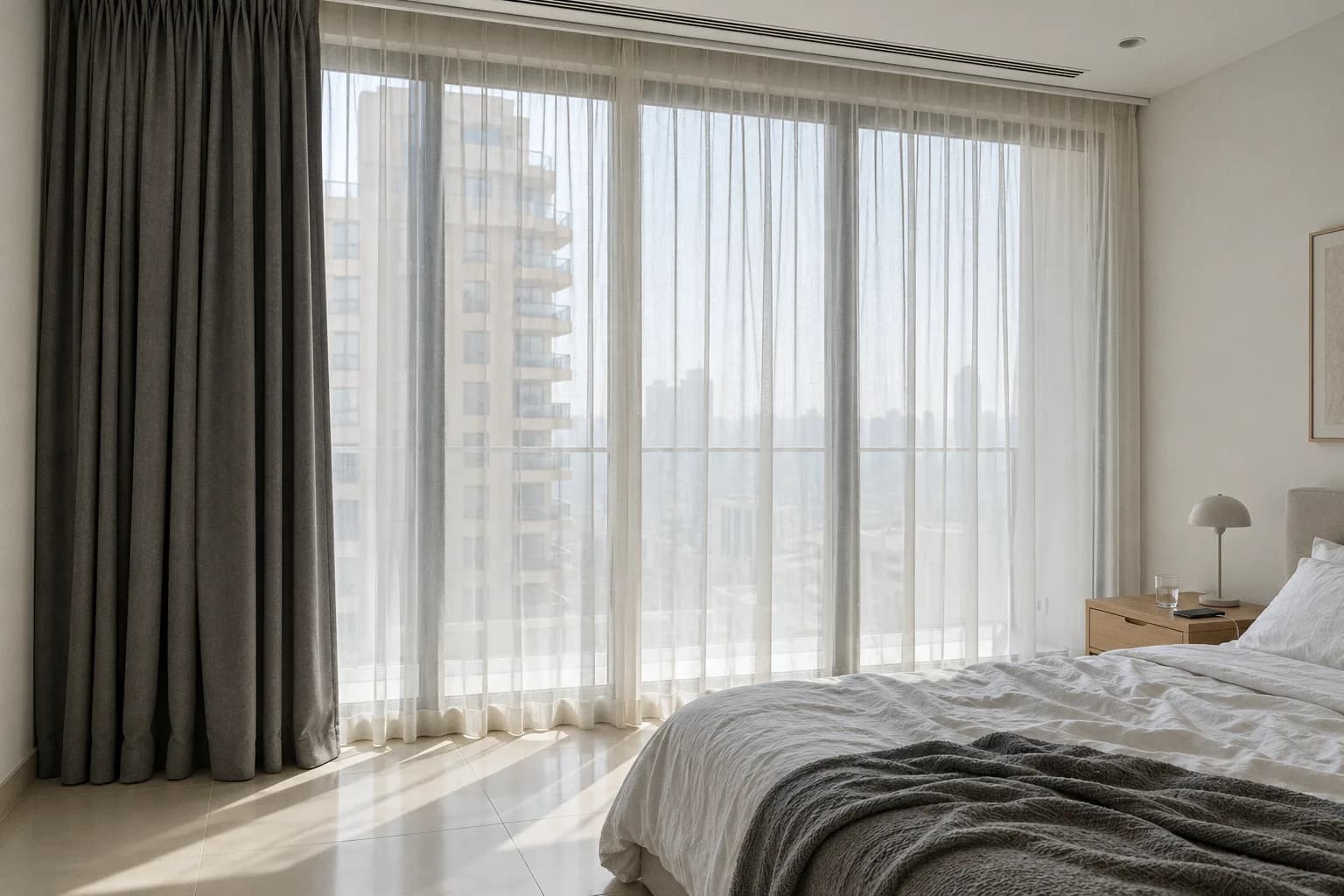
- A bedroom: blackout curtains on a ceiling track that covers the whole width of the glass, so there is no gap at the edges.
- A large or high window: a sheer roller blind in a low-openness fabric, or motorised curtains, on a timer so they close before the sun is on the glass. With a Somfy or Fujikawa motor, curtains and blinds go up and down from a remote, on a timer, or with Alexa or Google Home. Motorised roller blinds start at AED 1,925 and motorised curtains at AED 2,330 (indicative).
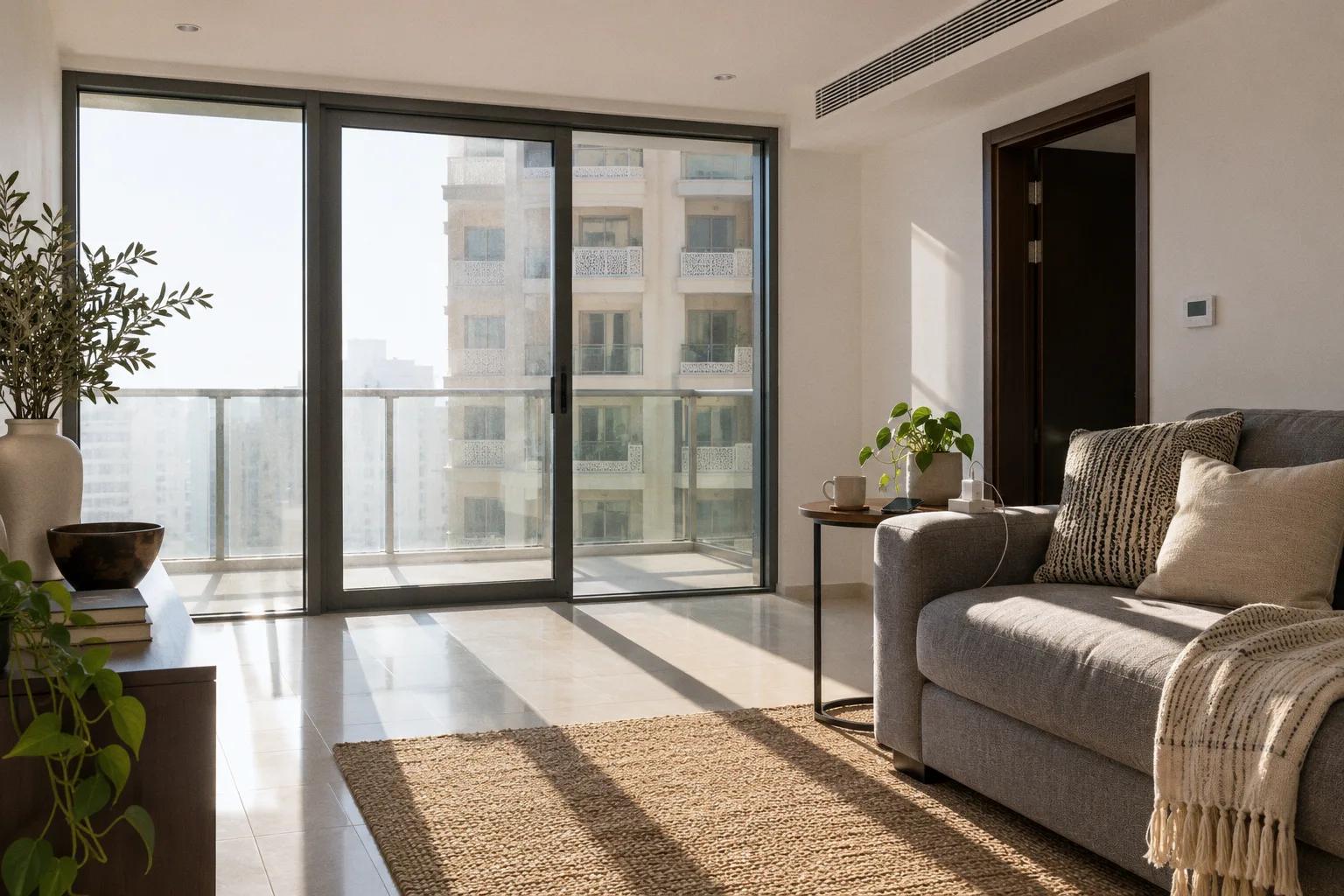
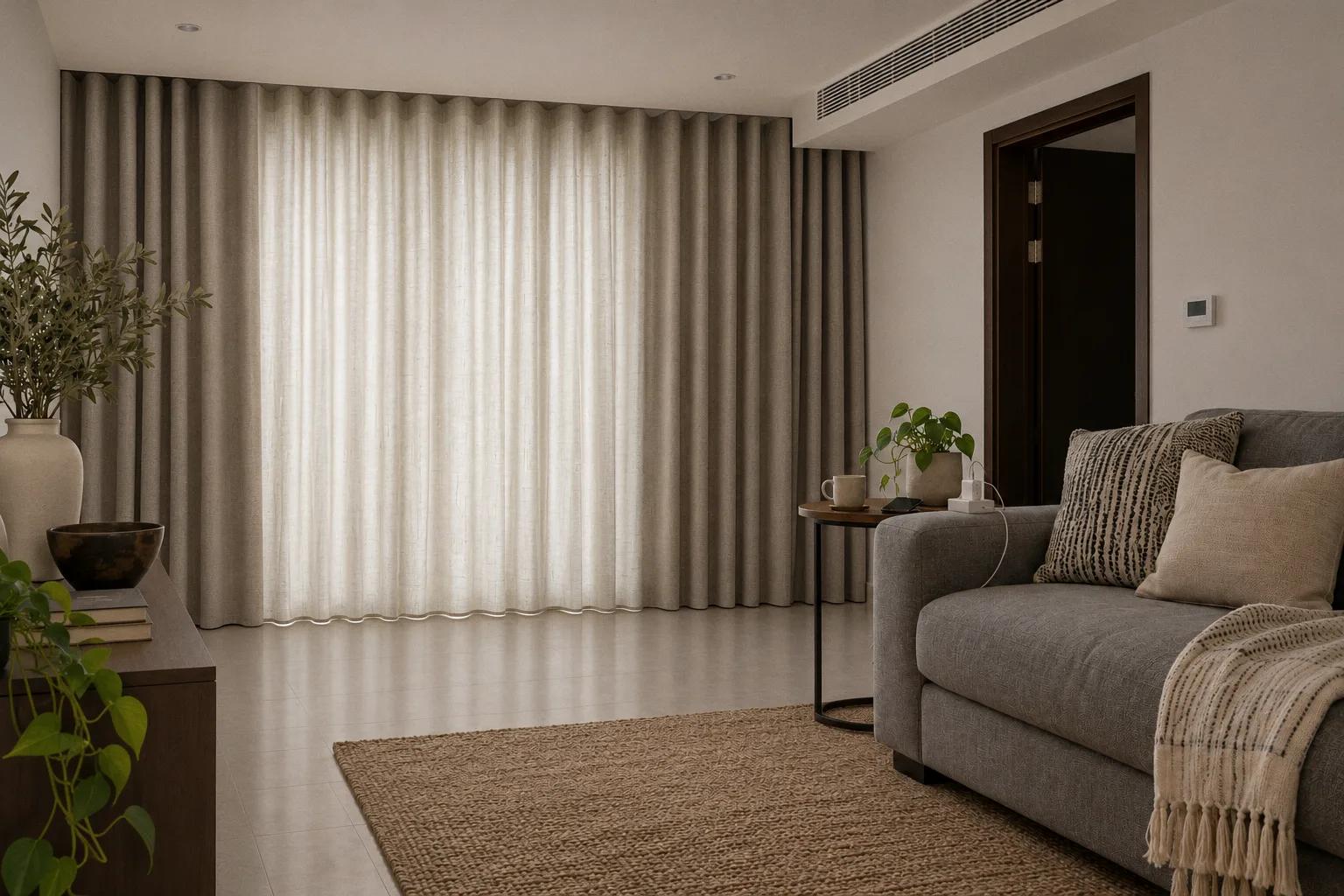
When to close them is simple. DEWA advises keeping blinds and curtains closed to reflect heat away from the house, and opening them in the late afternoon or early evening to let light in. On a west window the sun is still on the glass in the late afternoon, so open them once it has left.
Not sure which window gets the sun? Our window checklist for a new home shows how to note each window's direction. At the free home visit our consultant measures every window, brings fabric swatches to see in your own afternoon light, and recommends a covering for each.
Sources
- Cooling: use curtains, drapes, shades, awnings and reflective materials in summer (Dubai Electricity and Water Authority)
- Conservation booklet, general tips: keep blinds and curtains closed to reflect heat, open them in the late afternoon (DEWA)
- Energy efficient window attachments: awnings, curtains and drapes, solar screens (US Department of Energy, Energy Saver; page since moved)
- Window attachments: solar control and energy efficiency, exterior against interior (Pacific Northwest National Laboratory)
- Shading and solar control: east and west windows (Pacific Northwest National Laboratory, July 2023)
- Keeping the sun out: a guide to window attachments (BuildingGreen, July 2011)
- Glazing: angle of incidence, SHGC and window films (Your Home, Australian Government)
- Shading: east and west windows, low-angle sun (Your Home, Australian Government)
- Total system SHGC of clear, tinted and coated glass (National Construction Code 2019, Australia)
- Shading coefficient and short-wave radiant fraction for blinds and curtains, from BRE and ETSU data (IES Virtual Environment)
- Shading coefficient, and its conversion to SHGC (Wikipedia)
- Sunrise and sunset in Dubai, June 2026: solar noon altitude and sunset direction (timeanddate.com)
- Solar shades 101: openness, colour and privacy at night (Hunter Douglas, May 2022)
- Did you know? Color, openness and comfort (Draper, February 2022)
Questions people ask
What is the best curtain for a west-facing window in Dubai?
A double curtain: sheers for the morning and midday glare, and behind or in front of them a thick curtain with a light or white lining, closed before the sun reaches the glass. A medium-coloured drape with a white plastic backing cuts heat gain by about 33%, according to the US Department of Energy. Blackout curtains start at AED 630, and blackout with sheers at AED 1,020, for a 200 × 250 cm window (indicative, November 2026).
Do blackout curtains keep the heat out?
Partly. A closed, lined curtain stops the sun reaching the room and reflects some of it back through the glass, and a white or light back helps; the lining and a snug fit at the edges matter more than the word blackout. The curtain still sits inside the glass, so the glass and the air beside it get hot. Expect a cut of about a third to a half, not all of it.
Do sheer curtains cut the heat?
Very little. In published British test data a fine net curtain let in 0.76, and an open-weave one 0.85, of the heat that bare clear glass lets in. Sheers are for glare and for keeping the view and the daylight. For a west window, pair them with a lined curtain or a roller blind for the hot hours.
Is it better to shade a window from inside or outside?
Outside. Exterior shading blocks the sun before it passes the glass, while an interior curtain or blind works only after, as Pacific Northwest National Laboratory notes. The US Department of Energy puts the cut from awnings at up to 77% on west-facing windows. In a tower flat the facade belongs to the building, so most people shade from inside.
When should I close and open curtains on a west window?
Close them before the sun reaches the glass and keep them closed through the afternoon. DEWA advises keeping blinds and curtains closed to reflect heat away, and opening them in the late afternoon or early evening to let light in. On a west window, wait until the sun has left the glass. A timer on a motorised curtain or blind does this without you.
How much do curtains and blinds for a west window cost?
For one 200 × 250 cm window, including fabric, making and standard fitting: blackout curtains from AED 630, blackout with sheers from AED 1,020, roller blinds from AED 550, motorised roller blinds from AED 1,925 and motorised curtains from AED 2,330 (indicative, November 2026). Zebra blinds are priced at the free home visit, and your quote gives the final price, with VAT.